Planets

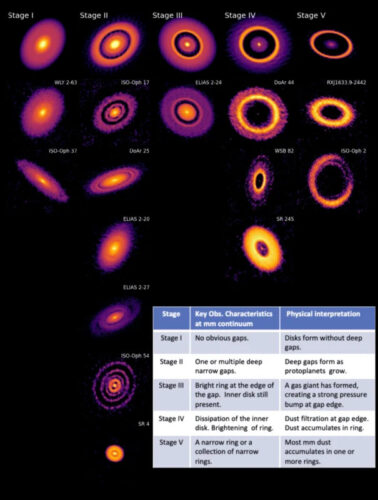
15 protoplanetary disks studied in the ODISEA project with their classification according to the proposed model

An article published in “The Astrophysical Journal Letters” reports a model that traces the evolution of protoplanetary disks through five stages. A team of researchers from the ODISEA (Ophiuchus DIsc Survey Employing ALMA) project developed this model using both simulations and observations of protoplanetary disks within the Ophiuchus molecular cloud obtained using the ALMA radio telescope. The type of evolution observed confirms the division into stages proposed in 2020 in an article published in the journal “Monthly Notices of the Royal Astronomical Society” and offers some confirmation of the mechanisms by which giant planets influence the dynamics within those disks.

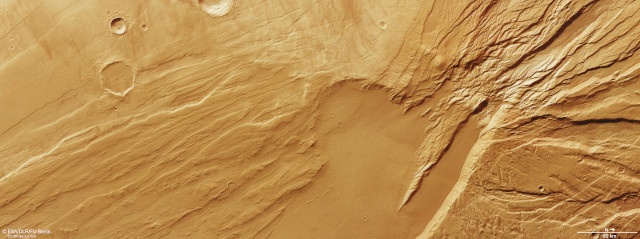
The area around the Acheron Fossae region on Mars

ESA has released images of the Acheron Fossae region on Mars captured by its Mars Express space probe’s High Resolution Stereo Camera (HRSC). The peculiarity of these images is that they show the two faces of Mars, meaning that they show how the red planet is basically divided into two parts with very different geological characteristics. About half of Mars is composed of an ancient terrain marked by craters and other signs of age and activity, while the other half is much smoother, with a surface probably reshaped by lava from volcanoes that are no longer active.

Artist’s Illustration of Exoplanets Orbiting Barnard’s Star (Image International Gemini Observatory/NOIRLab/NSF/AURA/P. Marenfeld)

An article published in “The Astrophysical Journal Letters” reports confirmation of the existence of four exoplanets that are smaller than Earth orbiting Barnard’s Star. A team of researchers combined detections obtained with the MAROON-X instrument mounted on the Gemini North telescope in Hawaii with others obtained independently with the ESPRESSO instrument installed on ESO’s VLT in Chile. The result is the confirmation of the exoplanet Barnard b, whose existence was announced in October 2024, and three other sub-Earths, small planets that are almost certainly rocky.

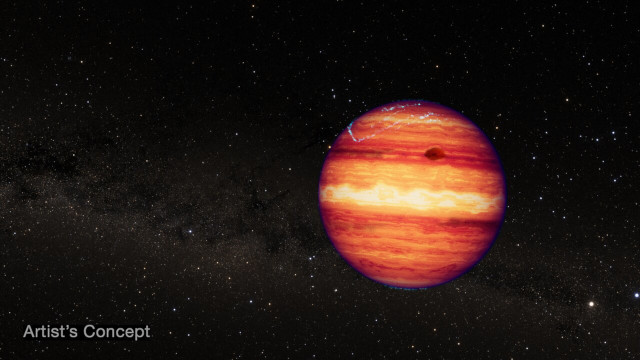
Artist’s concept of SIMP 0136 (Image NASA, ESA, CSA, J. Olmsted (STScI))

An article published in “The Astrophysical Journal Letters” reports the results of a study of the super-Jupiter object cataloged as SIMP J013656.5+093347.3 and referred to as SIMP J0136+09 or simply SIMP 0136. A team of researchers used observations conducted with the James Webb Space Telescope to monitor the infrared emissions from this object. Its nature is still undetermined because it has an estimated mass of around 13 times Jupiter’s, at the boundary between a planet and a brown dwarf. The result is the discovery of an atmosphere that varies quickly, probably due to layers of clouds with different chemical compositions.

The 3D structure of the atmosphere of the exoplanet Tylos

Two articles, one published in the journal “Nature” and one in the journal “Astronomy & Astrophysics”, report the results of two studies of the exoplanet WASP-121b, officially named Tylos, which describe different aspects of its very turbulent atmosphere. Two teams of researchers with several members in common used the ESPRESSO instrument mounted on ESO’s VLT (Very Large Telescope) in Chile exploiting the combination of the four telescopes to examine the atmosphere of Tylos during a complete transit in front of its star. The result was a mapping of the layers of the atmosphere and the detection of traces of various chemical elements including sodium, iron, and titanium.