Planets

The Alpha Centauri system as seen by the James Webb Space Telescope on the left, a zoom of the two main stars in the center, and a further zoom on the right indicating the exoplanet candidate designated as S1.

Two articles accepted for publication in “The Astrophysical Journal Letters” report different aspects of the study that led to the possible discovery of a gas giant planet orbiting the star Alpha Centauri A. Astronomers used observations with the James Webb Space Telescope’s MIRI instrument to identify a light source whose characteristics make it a candidate exoplanet. The information gathered suggests it may be a gas planet similar in size to Jupiter, although its mass could be close to Saturn’s. If confirmed, it would be the closest exoplanet orbiting a Sun-like star in its system’s habitable zone.

Arcadia Planitia on Mars

ESA has published a photo of the Arcadia Planitia region on Mars captured by its Mars Express space probe’s High Resolution Stereo Camera (HRSC). This is an interesting region from a geological point of view because it’s northwest of the large volcanoes of Tharsis, the largest in the entire solar system, and traces of ancient lava flows are still visible. It could be important for the exploration of the red planet if confirmation of the presence of frozen water right under the surface were to arrive.

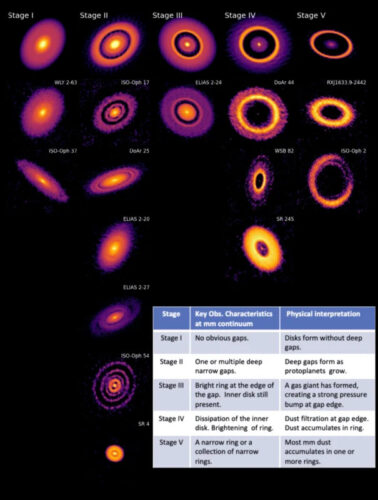
15 protoplanetary disks studied in the ODISEA project with their classification according to the proposed model

An article published in “The Astrophysical Journal Letters” reports a model that traces the evolution of protoplanetary disks through five stages. A team of researchers from the ODISEA (Ophiuchus DIsc Survey Employing ALMA) project developed this model using both simulations and observations of protoplanetary disks within the Ophiuchus molecular cloud obtained using the ALMA radio telescope. The type of evolution observed confirms the division into stages proposed in 2020 in an article published in the journal “Monthly Notices of the Royal Astronomical Society” and offers some confirmation of the mechanisms by which giant planets influence the dynamics within those disks.

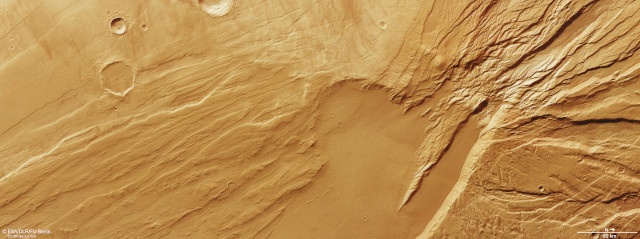
The area around the Acheron Fossae region on Mars

ESA has released images of the Acheron Fossae region on Mars captured by its Mars Express space probe’s High Resolution Stereo Camera (HRSC). The peculiarity of these images is that they show the two faces of Mars, meaning that they show how the red planet is basically divided into two parts with very different geological characteristics. About half of Mars is composed of an ancient terrain marked by craters and other signs of age and activity, while the other half is much smoother, with a surface probably reshaped by lava from volcanoes that are no longer active.

Artist’s Illustration of Exoplanets Orbiting Barnard’s Star (Image International Gemini Observatory/NOIRLab/NSF/AURA/P. Marenfeld)

An article published in “The Astrophysical Journal Letters” reports confirmation of the existence of four exoplanets that are smaller than Earth orbiting Barnard’s Star. A team of researchers combined detections obtained with the MAROON-X instrument mounted on the Gemini North telescope in Hawaii with others obtained independently with the ESPRESSO instrument installed on ESO’s VLT in Chile. The result is the confirmation of the exoplanet Barnard b, whose existence was announced in October 2024, and three other sub-Earths, small planets that are almost certainly rocky.