Planets

Artist's concept of the exoplanet Wasp-103b and its star (Image ESA)

An article published in the journal “Astronomy & Astrophysics” reports a study of the exoplanet Wasp-103b that offers evidence of its oval shape. A team of researchers used data collected by ESA’s CHEOPS space telescope to have the accuracy needed to assess this gas giant’s anomalous shape. It’s due to its star’s powerful tidal forces, as the star is a bit larger and more massive than the Sun, on this planet due to their proximity. In fact, Wasp-103b is so close to its star that its year lasts a little less than an Earth day.

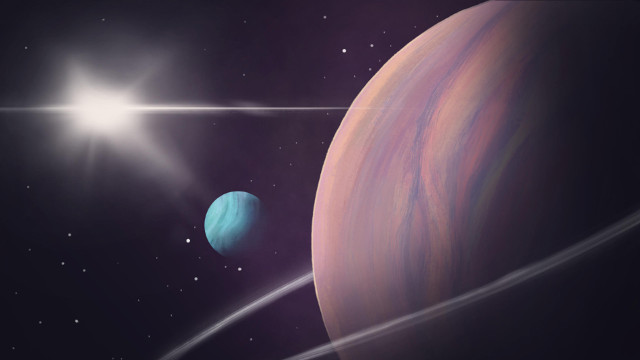
Artist's concept of the exoplanet Kepler-1708 b with its moon (Image courtesy Helena Valenzuela Widerström)

An article published in the journal “Nature Astronomy” reports the discovery of an exomoon candidate that was cataloged as Kepler-1708 b-i. A team of researchers led by David Kipping of Columbia University analyzed data collected by NASA’s Kepler Space Telescope with the specific purpose of looking for possible moons around exoplanets discovered thanks to Kepler. The Jupiter-sized gas giant Kepler-1708 b has a signal indicating the possible presence of a moon that would be a little smaller than the planet Neptune.

Jupiter's North Pole with eight cyclones surrounding a central cyclone

An article published in the journal “Nature Physics” describes similarities between the cyclones present at the planet Jupiter’s poles and the vortices existing in the Earth’s oceans. A team of researchers used images captured by NASA’s Juno space probe of Jupiter cyclones to study them, compare them with similar ocean phenomena, and describe them by applying geophysical fluid dynamics. The conclusion is that Jupiter cyclones are also produced and continue their existence thanks to convection phenomena that lead masses of hot gas to rise and then cool down and descend again into the deeper layers of the Jovian atmosphere.

The Valles Marineris (Image ESA/DLR/FU Berlin (G. Neukum), CC BY-SA 3.0 IGO)

An article published in the journal “Icarus” reports the identification of traces of water in the subsoil of the Valles Marineris, the largest system of canyons on the planet Mars. A team of researchers used data collected by FREND instrument of TGO space probe, part of ESA and Roscosmos’ ExoMars program, to map hydrogen, generally bound to oxygen into water molecules, in the soil’s upper layer. The area marked by the presence of water has a size close to those of the Netherlands, and part of it is located in the valleys of Candor Chasma, in the northern part of the Valles Marineris. That marks the discovery of water in the equatorial regions of Mars, where it was believed that temperatures were not low enough to prevent the sublimation of water so close to the surface.

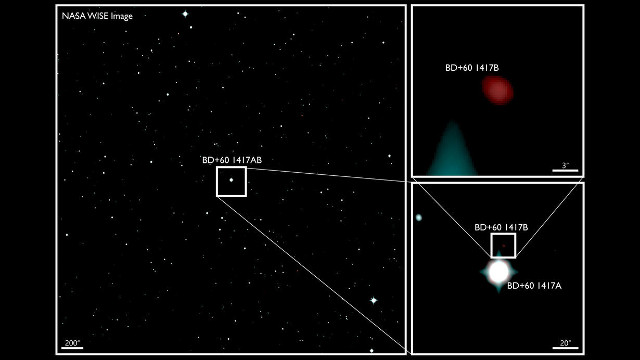
BD+60 1417's system

An article published in “The Astrophysical Journal” reports the discovery of an object orbiting BD+60 1417, a young star a little smaller than the Sun, which could be a gas giant planet but also a small brown dwarf. Amateur astronomer Jörg Schümann spotted a moving object by examining images in the “Backyard Worlds: Planet 9” program that anyone can participate in. A team led by Jackie Faherty of the American Museum of Natural History used various telescopes to confirm the existence of the object, cataloged as CWISER J124332.12+600126.2 or simply W1243. Its mass was estimated between 10 and 20 times the planet Jupiter’s, around the border between planet and brown dwarf, estimated around 13 Jupiter masses. The object had escaped previous research probably because its distance from its star is about 1660 times that of the Earth from the Sun.