Planets

Radar map of the Mars area where the lake system was found (Image courtesy Sebastian Emanuel Lauro et al. Nature Astronomy, 2020)

An article published in the journal “Nature Astronomy” reports the discovery of new underground lakes of very salty liquid water under the planet Mars’ south pole cap. A team of researchers led by Elena Pettinelli and Sebastian Lauro, both of the Italian Roma Tre University, used data collected by ESA’s Mars Express space probe’s Mars Advanced Radar for Subsurface and Ionosphere Sounding (MARSIS) instrument to discover what form a lake system consisting of three main lakes surrounded by other smaller lakes. This confirms the discovery of a lake announced in July 2018 and offers evidence that this is not a unique case. It remains an extreme environment, so it takes some speculation to imagine life forms in those lakes, but the authors of this new research also recommend increasing the exploration of those areas to understand their potential is to host life.

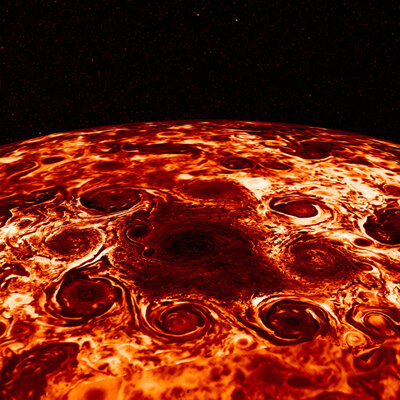
Jupiter's South Pole (Image NASA-JPL/Caltech)

An article published in the journal “Proceedings of the National Academy of Sciences” reports a study on storms at the planet Jupiter’s south pole and their regular geometric pattern. A team of researchers from the University of Berkeley and Caltech used mathematical models derived from 19th-century research by Lord Kelvin based on experiments by physicist Alfred Mayer to explain why those storms concentrated in that area and why on Jupiter they’re arranged in that geometric formation.

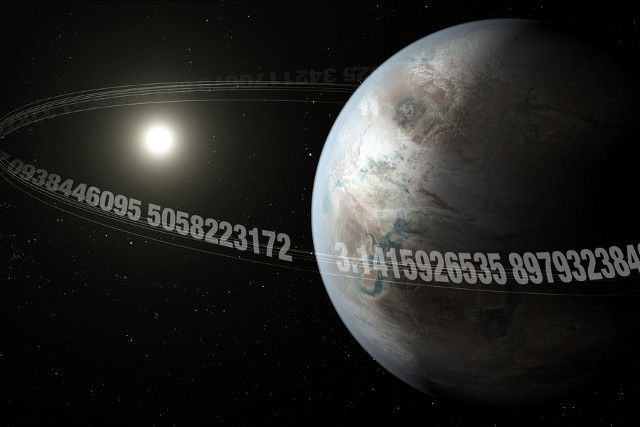
Artist's concept of Pi Earth (Image courtesy NASA Ames/JPL-Caltech/T. Pyle, Christine Daniloff, MIT)

An article published in “The Astronomical Journal” reports a study on the exoplanet K2-315b, nicknamed Pi Earth because its year lasts 3.14 Earth days, an approximation of the value of pi. A team of researchers from the SPECULOOS (Search for habitable Planets EClipsing ULtra-cOOl Stars) project, a network of ground-based telescopes, used them to confirm the planet’s existence by verifying data collected by NASA’s Kepler Space Telescope. Pi Earth is very close to its star so the temperature on its surface is very high even if the star is very small and relatively cold. Any life forms should be analogous to terrestrial extremophiles. It may be lifeless but it is an interesting candidate for studying its atmosphere.

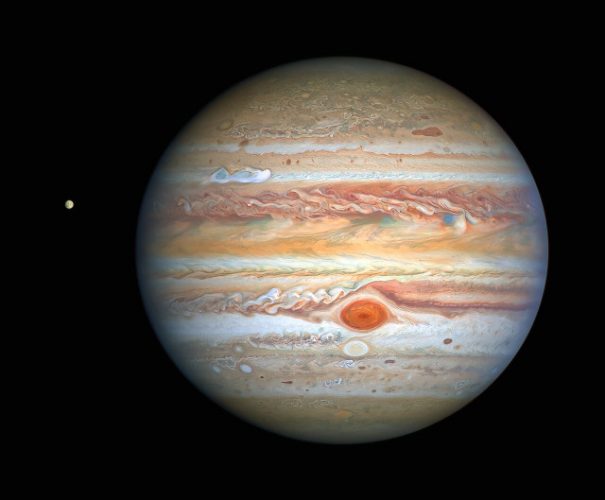
Jupiter and Europa seen by Hubble (Image NASA, ESA, A. Simon (Goddard Space Flight Center), and M. H. Wong (University of California, Berkeley) and the OPAL team.)

New images of the planet Jupiter captured by the Hubble Space Telescope show the gigantic storms sweeping through it, including a new one in the middle of the Northern Hemisphere that appears as a multiple whitish spot and what was called a cousin of the Great Red Spot because it’s little to south of it has changed color once again. Hubble also captured an image of Jupiter along with Europa, one of its major moons that became famous after the discovery of a subterranean ocean of liquid water in which conditions could be favorable to life.

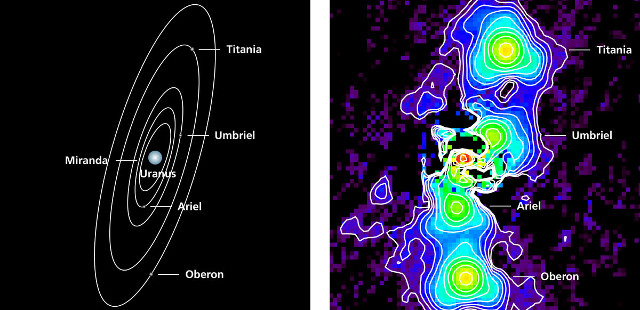
Uranus' moons seen by Herschel

An article published in the journal “Astronomy & Astrophysics” reports the results of a research on the five major moons of the planet Uranus. A team of researchers led by Örs H. Detre of the Max Planck Institute for Astronomy (MPIA) in Heidelberg, Germany, analyzed data collected by ESA’s Herschel Space Observatory using a new technique that made it possible to obtain new information from the weak signals obtained in the past to determine the physical characteristics of the moons Titania, Oberon, Umbriel, Ariel, and Miranda. The results indicate that they’re similar to the trans-Neptunian dwarf planets while they’re different from other moons of Uranus leaving open the possibility that they were captured by the planet after their formation.