Planets

The presence of toxic gases could limit the habitability of rocky exoplanets

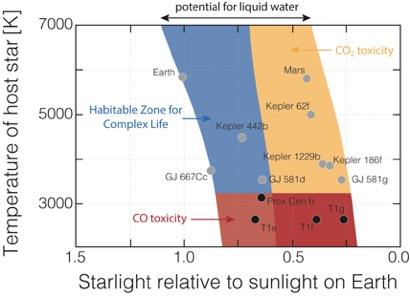
An article published in the journal “The Astrophysical Journal” offers a new definition of the habitable zone of ​​a star system where a planet that can accommodate life forms similar to the Earth’s can orbit. A team of researchers coordinated by the University of California – Riverside examined the available data on the atmospheres of exoplanets with orbits in what until now has been considered the habitable zone discovering that in most cases there’s an amount of carbon dioxide and carbon monoxide toxic for complex life forms as we know them. In essence, the new definition significantly reduces the habitable zone.

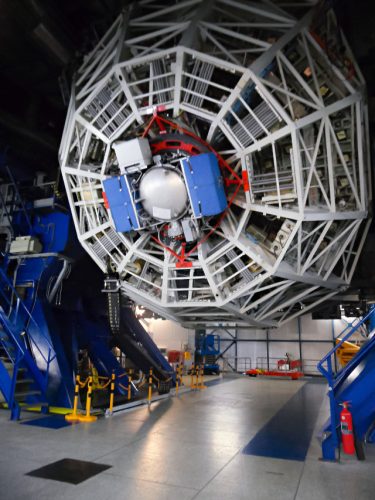
The NEAR instrument (Photo ESO/ NEAR Collaboration)

The NEAR (Near Earths in the AlphaCen Region) instrument mounted on the ESO VTL in Chile saw the so-called first light, which means that it made its first observation after being activated. This instrument is designed to detect exoplanets in the Alpha Centauri system, made up of two stars which, together with their farther and smaller companion Proxima, are the closest to the Sun at a distance of about 4.3 light years. ESO collaborated in this project with the Breakthrough Watch program.

Artist's concept of the exoplanet NGTS4b and its star (Image courtesy University of Warwick/Mark Garlick)

An article published in the journal “Monthly Notices of the Royal Astronomical Society” reports the discovery of an exoplanet belonging to the mini-Neptune class in an orbit close to its star, where a planet of that type should not exist, so much that it’s called Neptunian Desert. A team of astronomers coordinated by the University of Warwick used the Next-Generation Transit Survey (NGTS) array in Chile to locate the exoplanet, which was therefore cataloged as NGTS-4b. It may have got closer to its star or was originally larger but part of its atmosphere was consumed by stellar radiation.

Nakhla meteorite (Photo NASA)

An article published in the journal “Geochimica et Cosmochimica Acta” reports the evidence that on the planet Mars there were hydrothermal springs and an atmosphere much thicker than the current one until just over a billion years ago. A team of researchers led by planetary geologist Nicola Mari of the University of Glasgow studied 5 of the 20 Martian meteorites from the group of nakhlites identified on Earth, analyzing in particular sulfur isotopes finding traces of hydrothermal springs and a thick atmosphere of up to about 1.3 billion years ago. An environment capable of sustaining life forms similar to the the Earth’s still existed at that time, more than two billion later than previously thought.

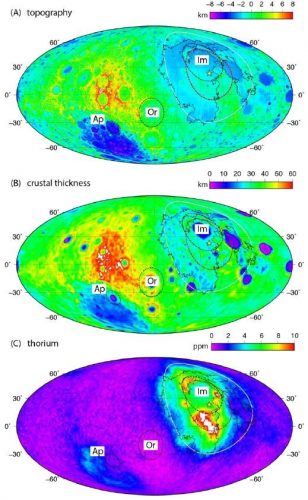
The differences between the two faces of the Moon could be due to the impact of a dwarf planet

An article published in the “Journal of Geophysical Research: Planets” reports the results of computer simulations generated to explain the asymmetry of the two faces of the Moon. A team of researchers used data from NASA’s GRAIL mission as a reference to try to reproduce the Moon’s situation, concluding that the best explanation comes from the simulation of the impact of a dwarf planet with a diameter of about 780 kilometers on the current Earth-facing Moon’s side at about 22,500 km/h.