Planets

The Caralis Chaos on Mars

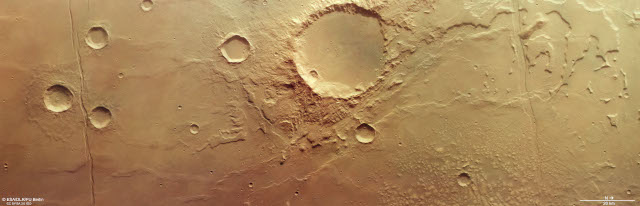
An image captured by ESA’s Mars Express space probe’s High Resolution Stereo Camera (HRSC) shows the region of the planet Mars called Caralis Chaos. At first glance, it may seem like just another Martian area dotted with craters and wind-carved mounds, but when the red planet was young, it was home to Lake Eridania, larger than all the lakes on Earth. It covered an area of ​​more than a million square kilometers, including Atlantis Chaos, an area close to Caralis Chaos. That lake gradually dried up as the environmental collapse transformed an Earth-like planet into the one we see today.

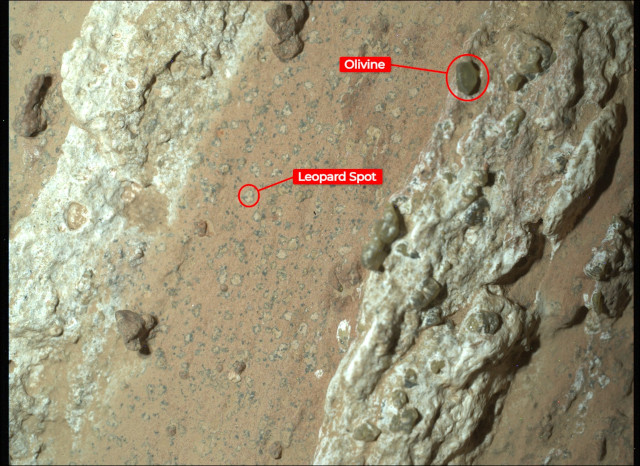
The Cheyava Falls Rock Found on Mars (Image NASA/JPL-Caltech/MSSS)

NASA’s Mars Rover Perseverance discovered a rock that contains chemical signatures and structures that might have been created by ancient Martian life forms. The rock, nicknamed Cheyava Falls, was found in Neretva Vallis during Perseverance’s journey inside Jezero Crater on Mars and was examined with the SHERLOC (Scanning Habitable Environments with Raman & Luminescence for Organics & Chemicals) instrument. The rock contains organic compounds, but it’s currently not possible to rule out that they formed through non-biological processes. The PIXL (Planetary Instrument for X-ray Lithochemistry) instrument detected iron and phosphates in black halos on the rock.

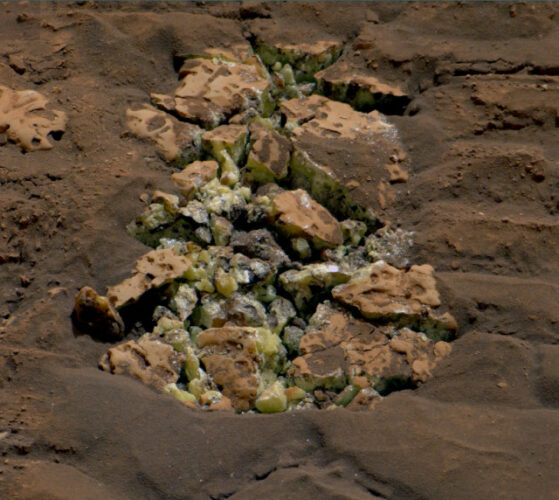
The rocks that include yellow crystals of pure sulfur in Gediz Vallis on Mars (Image NASA/JPL-Caltech/MSSS)

NASA’s Mars Rover Curiosity found a Martian rock containing crystals of elemental sulfur, which means it’s pure sulfur. In the past, in the same area, the Gediz Vallis channel’s area, the presence of sulfur in various compounds was detected but it’s the first time that it was detected in its pure form. It’s such an anomaly that its discovery was compared to that of an oasis in the desert. A field with stones made of pure sulfur shouldn’t exist on Mars, and scientists following Curiosity’s exploration of Mount Sharp, at the center of Gale Crater, will have more work to do to explain its formation.

Artist’s Impression of a Hot Jupiter Progenitor with its star in the background (Image NOIRLab/NSF/AURA/J. da Silva (Spaceengine))

An article published in the journal “Nature” reports a study on the exoplanet cataloged as TIC 241249530 b which labels it as a progenitor of a hot Jupiter. A team of researchers used various telescopes to study TIC 241249530 b and try to understand its characteristics and evolution. This gas giant has an extremely eccentric orbit, meaning it’s extremely elongated, which could change greatly as time passes.

Observations and simulations suggest that the star’s gravitational action will drive this planet to have an almost circular orbit close to the star itself. This led the researchers to conclude that TIC 241249530 b is in the first phase of a planetary migration. The star is slightly more massive than the Sun and has an age estimated at just over three billion years, which indicates that these processes can begin well after the formation of a planetary system.

Aganippe Fossa

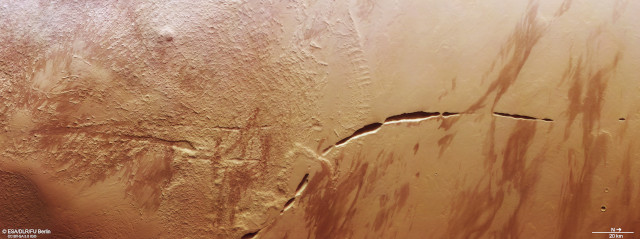
ESA has published an image captured by its Mars Express space probe’s High Resolution Stereo Camera (HRSC) instrument of Aganippe Fossa, a formation that has the appearance of a scar on the surface of the planet Mars which is truly colossal given that it’s approximately 600 kilometers long. This rift valley is a geological formation of the type called graben in jargon. There are no certainties about its formation but it’s probably linked to lava flows under the enormous volcanoes of the Tharsis region, starting with Arsia Mons, the closest to Aganippe Fossa.