Planets

Artist's concept of the CI Tauri system with its planets (Image courtesy Amanda Smith, Institute of Astronomy)

An article published in the journal “The Astrophysical Journal” describes the discovery of four gas giant planets orbiting the young star CI Tauri. A team of researchers coordinated by the British University of Cambridge used the ALMA radio telescope to study that star system in which one of the four planets had already been discovered, a hot Jupiter that was the first in its class to be discovered in a very young system. There’s still a protoplanetary disc that revealed gaps where the other planets formed, much farther than the one already known.

Artist's concept of the planet Kepler-1625b with its moon and its star in the background (Image NASA, ESA, and L. Hustak (STScI))

An article published in the journal “Science Advances” presents the evidence of the existence of a exomoon, a moon orbiting a planet of another solar system, named Kepler-1625b-I. David Kipping and Alex Teachey of Columbia University used observations of the Kepler and Hubble space telescopes to examine the traces left by the exoplanet Kepler-1625b in front of its star, similar to the Sun. The first indications of the discovery of the exomoon candidate were revealed in July 2017, follow-up observations carried out with the Hubble Space Telescope provided new confirmations.

The discovery images of 2015 TG387 (Image courtesy Scott Sheppard. All rights reserved)

An article submitted for publication in “The Astronomical Journal” describes the discovery of 2015 TG387, an object with a length estimated around 300 kilometers (186 miles) whose distance from the Sun is about 80 times the Earth’s. A team of astronomers led by Scott Sheppard of the Carnegie Institution for Science saw it for the first time on October 13, 2015 during the research of another planet beyond Pluto’s orbit. This orbit of this object – which was nicknamed The Goblin – and those of the dwarf planet Sedna and the possible dwarf planet 2012 VP113 could be explained by the presence of a planet that’s still unknown.

Artist's concept of the planet HD 39091c with its star (Image NASA/MIT)

An article to be published in the “Astrophysical Journal Letters” reports the discovery of the exoplanet HD 39091c, the first identified thanks to NASA’s TESS space telescope. It’s a super-Earth with a radius of 2.14 ± 0.04 the Earth’s and a mass estimated at 4.82 ± 0.85 the Earth’s. It’s very close to its star, which is a little larger than the Sun, with a year that lasts just over 6 Earth days.

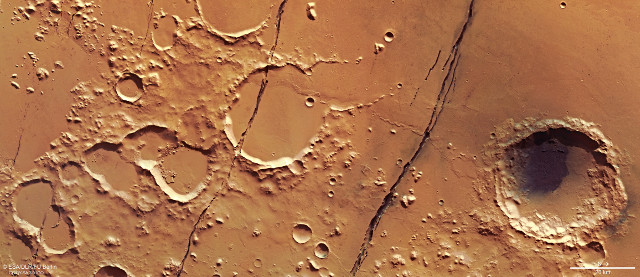
The Cerberus Fossae (Image ESA/DLR/FU Berlin, CC BY-SA 3.0 IGO)

ESA has published photos taken by its Mars Express space probe of the Cerberus Fossae, fractures that run almost parallel for more than 1,000 kilometers in the area near the equator of the planet Mars. They’re part of a large volcanic complex called Elysium Planitia, where traces suggest that lava flows date back a few million years ago, recent in geological terms compared to the bulk of volcanic activity. The Cerberus Fossae were also formed relatively recently, less than 10 million years ago, probably originated from faults that stretched the upper layers of the surface apart.