Planets

Mars Express detections at Mars South Pole

An article published in the journal “Science” describes the discovery of an underground lake of liquid water on Mars. A team of researchers led by Roberto Orosei of the National Institute of Astrophysics and composed of researchers belonging to Italian research centers and universities used data collected by ESA’s Mars Express space probe’s MARSIS radar to collect evidence that at the south pole at about 1.5 kilometers of depth there’s water that is liquid.

Mars Proton Aurora

An article published in the journal “Nature Astronomy” describes the discovery of proton aurorae on the planet Mars. Scientists from NASA’s MAVEN mission were studying the red planet’s atmosphere using the space probe’s IUVS instrument and noticed a strange glow in its upper layers. The investigation led to the discovery of this rare type of aurora caused by energetic protons carried by the solar wind, a phenomenon that can occur on a large scale on Mars and perhaps also on Venus and Titan while it’s limited on Earth.

Pluto

NASA has published new images of the dwarf planet Pluto and its largest moon Charon which reproduce with the greatest possible accuracy their natural colors. This processing celebrates the 3rd anniversary of the New Horizons space probe’s July 14, 2015 flyby, but also the 40th anniversary of the discovery of Charon, identified by the astronomer James Christy on June 22, 1978 and confirmed in the following days thanks to other observations.

Mars

NASA has activated all the possibilities of close study of the global dust storm that is affecting the planet Mars. This type of event usually occurs once every three or four Martian years (between six and eight Earth’s years) but it is still unclear how a dust storm that starts on a small scale can grow to the point of enveloping the entire planet. Space probes in orbit are studying the phenomenon in various ways and the Mars Rover Curiosity is collecting data on the ground while the situation of the Mars Rover Opportunity is difficult because it can’t use its solar panels so it went into hibernation.

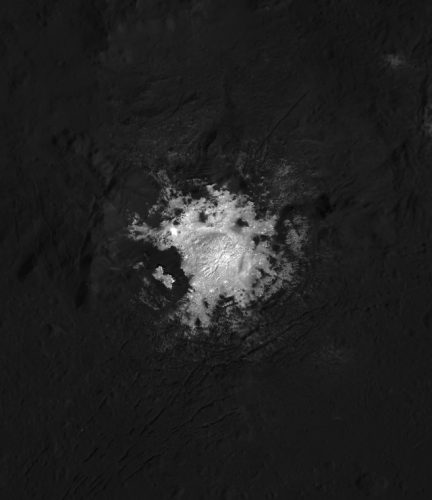
Cerealia Facula in Occator Crater (Image NASA/JPL-Caltech/UCLA/MPS/DLR/IDA)

At the Committee on SPAce Research (COSPAR) meeting held this week in Pasadena, NASA’s JPL scientists are presenting the latest information gathered by NASA’s Dawn space probe about the dwarf planet Ceres. In particular, there’s an attention on Occator Crater, the most famous crater thanks to its brightness due to the various bright spots made of salts inside it, now called faculae. In the next few months Dawn will finish its mission but will continue to collect data from the lowest orbit at only 34-35 kilometers (about 21 miles) of altitude.