Planets

Artist's concept of lightning distribution in Jupiter's northern hemisphere (Image NASA/JPL-Caltech/SwRI/JunoCam)

Two articles, one published in the journal “Nature” and one published in “Nature Astronomy”, describe two researches on Jovian lightning. A team led by Shannon Brown of NASA’s JPL described the ways in which lightning strikes on the planet Jupiter are similar to those on Earth even if they’re someway the opposite. Another team led by Ivana Kolmašová of the Czech Academy of Sciences in Prague created the largest database of low-frequency radio emissions generated by lightning strikes on Jupiter, called in jargon whistlers. In both cases, the researchers used data collected by NASA’s Juno space probe.

The Mars Rover Curiosity and two elements found (Image NASA/GSFC)

In a press conference, NASA announced the latest discoveries on the planet Mars obtained thanks to the analyzes carried out by the Mars Rover Curiosity. In some new samples taken at two sites of Gale Crater, various organic compounds were detected. The methane measurements in Mars atmosphere indicate a seasonal cycle in which its amount varies. These findings have been described in detail in two articles published in the journal “Science”.

Sputnik Planitia

An article published in the journal “Icarus” describes a research that offers an explanation for the formation of the dwarf planet Pluto. A team of scientists from the Southwest Research Institute (SwRI) put together data collected by NASA’s New Horizons space probe and data collected by ESA’s Rosetta space probe, which studied comet 67P/Churyumov-Gerasimenko, concluding that Pluto formed by the union of about a billion comets similar to it.

Artist's representation of WASP-96b (Image courtesy Engine House. All rights reserved)

An article published in the journal “Nature” describes a research on the exoplanet WASP-96b. It’s a hot Saturn, meaning a gas giant with a Saturn-like mass and an orbit close to its star which has as a consequece a high temperature on its surface. A team of researchers led by Nikolay Nikolov of the British University of Exeter used the FORS2 spectrograph mounted on ESO’s VLT to study WASP-96b discovering strong traces of sodium, an observation possible only in the absence of clouds in its atmosphere.

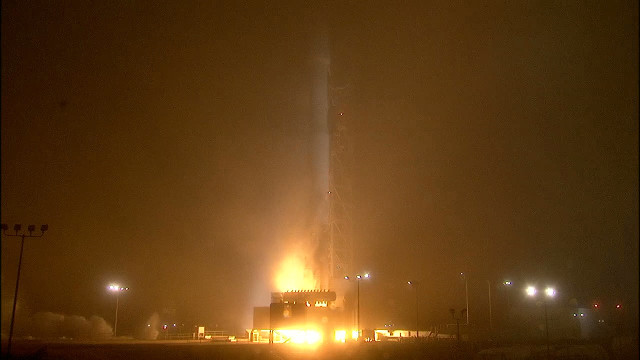
The InSight lander and the MarCO nanosatellites blasting off atop an Atlas V 401 rocket (Image NASA TV)

A few hours ago NASA’s InSight lander was launched together with the two Mars Cube One nanosatellites from the Vandenberg base on an Atlas V 401 rocket. After about 1.5 hours they separated from the rocket’s last stage, called Centaur, and went en route to Mars.

The InSight (Interior Exploration using Seismic Investigations, Geodesy and Heat Transport) mission aims to investigate the geology of the planet Mars. A lander equipped with a seismometer, a thermal sensor and other instruments that will analyze the red planet’s internal structure. This will allow to obtain new data on its formation, also contributing to the existing models on the formation of rocky planets such as the Earth.