Planets

The Grand Canyon and Mars

An article published in the journal “Nature Geoscience” describes a research on the possible rainfall that occurred on the planet Mars when it was young. Ramses Ramirez and Robert Craddock, two scientists who have been studying the red planet’s geological and climatic history for years, claim that about 4 billion years ago the climate could be warm and semi-arid with rainfall.

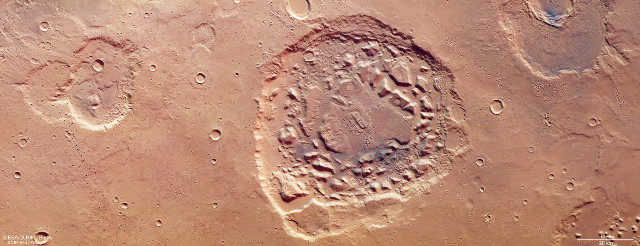
Ismenia Patera (Image ESA/DLR/FU Berlin, CC BY-SA 3.0 IGO)

ESA has published new images of a crater called Ismenia Patera on the planet Mars captured by the Mars Express space probe. The red planet is full of craters but this is unique because generally those formations are the result of a meteorite impact while Ismenia Patera could be what remains of a supervolcano that was active when Mars was very young. A very violent volcanic activity may have caused the destruction of other traces of a supervolcano at the same time creating the strange, somewhat irregular formation we see today.

Almahata Sitta meteorite fragment

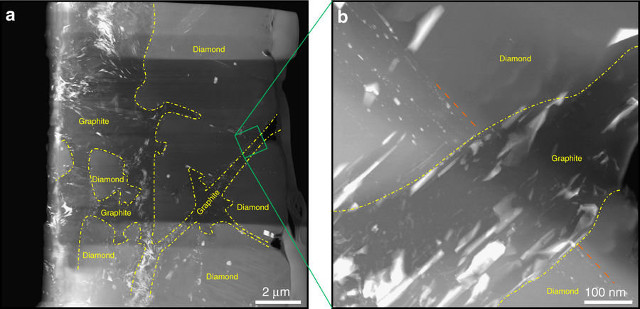
An article published in the journal “Nature Communications” describes a study of microscopic diamonds discovered inside the Almahata Sitta meteorite, a fragment of a larger meteorite exploded in the Earth’s atmosphere on October 7, 2008. A team of researchers analyzed those diamonds concluding that they contain compounds that can only form within a planet, so they must be the remnants of a lost planet with a size between that of Mercury and Mars.

An infrared 3-D image of Jupiter's North Pole (Image NASA/JPL-Caltech/SwRI/ASI/INAF/JIRAM)

During the general assembly of the European Geosciences Union General Assembly in Vienna, scientists of NASA’s Juno mission showed a 3D map that reproduces cyclones and anticyclones in the planet Jupiter’s polar regions. In particular, they created an animation of a flight over the North Pole. Using data collected by the Juno space probe they were also able to create the first detailed view of the dynamo that powers the planet’s magnetic field.

Star systems observed by the SPHERE instrument (Image ESO/H. Avenhaus et al./E. Sissa et al./DARTT-S and SHINE collaborations)

Two articles, one published in the “Astrophysical Journal” and one in “Astronomy & Astrophysics”, describe two researches on a number of star systems. Two teams used the SPHERE instrument mounted on ESO’s VLT in one case to study dust and gas disks around a number of young stars in their formation stage and in the other case to study a pair of disks in a system with three stars.