Planets

Jupiter's Great Red Spot (Photo NASA/JPL-Caltech/SwRI/MSSS/Jason Major)

Yesterday NASA started publishing the first raw photos of Jupiter’s Great Red Spot taken by the Juno space probe during its July 10 flyby. All the scientific instruments were active but JunoCam is the one that has obtained the most spectacular results with the pictures of the iconic storm larger than the Earth. From now on, many fans started processing the images by contributing to the NASA database.

Exoplanets and binary systems (Image NASA/JPL-Caltech)

An article to be published in the “Astronomical Journal” describes a study of possible errors made in the density estimates of the exoplanets discovered using the transit method. Elise Furlan of Caltech/IPAC-NExScl and Steve Howell of NASA’s Ames Research Center analyzed the effect of the presence of a companion star on estimating the density of exoplanets in those systems, concluding that some of them are actually less dense than calculated.

The area around the pulsar Geminga (Image Jane Greaves / JCMT / EAO)

An article published in the journal “Monthly Notices of the Royal Astronomical Society” describes a research for possible planets in formation orbiting the pulsar Geminga. The astronomers Jane Greaves and Wayne Holland used the James Clerk Maxwell Telescope (JCMT) in Hawaii to conduct observations at submillimetric wavelengths and understand the mechanisms of planet formation in a system after a supernova.

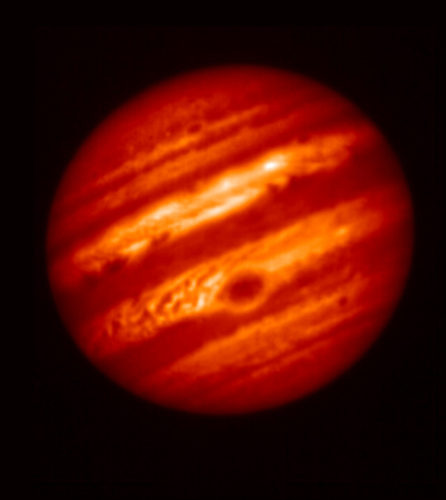
Jupiter seen by the Subaru telescope (Photo NAOJ/NASA/JPL-Caltech)

Two telescopes in Hawaii were used for new observations of the planet Jupiter and in particular of its famous Great Red Spot. They were conducted to support NASA Juno space probe’s mission, which on July 10 will fly over the giant jovian storm. The Gemini North telescope was used with special near-infrared filters to produce specific colors that can penetrate Jupiter’s upper atmosphere and clouds. The Subaru telescope’s COMICS instrument was used with mid-infrared filters.

Perseverance Valley (Image NASA/JPL-Caltech/Cornell/Arizona State Univ.)

NASA’s Mars Rover Opportunity is working in an ancient valley on the edge of Endeavour Endeavour’s rim called “Perseverance Valley” examining rocks and driving around the area to carry out a survey of the place. According to plans, once these tasks are completed Opportunity will go down to the lower part of the valley but the maneuver will have to be even more cautious than expected due to a problem encountered in one of the wheels’ steering system.