Planets

2014 UZ224 / DeeDee seen by ALMA (Image ALMA (ESO/NAOJ/NRAO))

An article accepted for publication in the “Astrophysical Journal Letters” describes the research that followed the discovery of a possible dwarf planet called 2014 UZ224 and nicknamed DeeDee, as in Distant Dwarf. A team led by David Gerdes of the University of Michigan announced its discovery in October 2016 and thanks to a further observation carried out by the ALMA radio telescope they estimated other features.

The triple crater in the Terra Sirenum region on Mars (Image ESA/DLR/FU Berlin, CC BY-SA 3.0 IGO)

ESA has published some new pictures taken by its Mars Express space probe that show a curious crater in the Terra Sirenum region on Mars. It’s a crater with an elongated shape having a length of about 45 kilometers (about 28 miles) and a width of approximately 24 kilometers (about 15 miles). It’s probably the result of an asteroid impact that broke up into three parts when it was still above the surface causing the triple impact of fragments that were still very close. The sedimentary deposits on the bottom of the crater suggest that in ancient times water existed in that region of Mars.

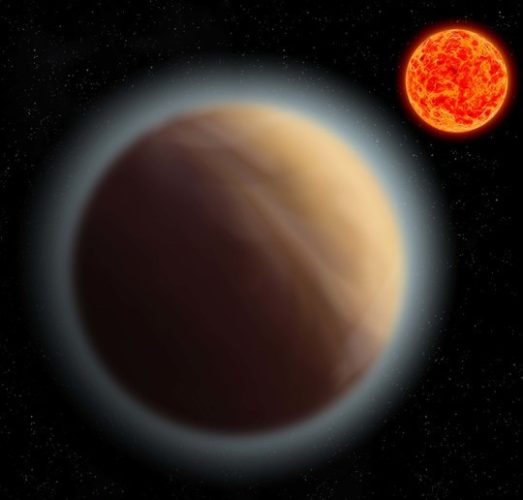
Artistic concept of the exoplanet GJ 1132b and its star (Image courtesy MPIA)

An article published in “The Astronomical Journal” describes a research about the exoplanet GJ 1132b. A team led by Dr. John Southworth of Keele University and by Italian INAF associate Luigi Mancini used the 2.2-meter ESO/MPG telescope in Chile to directly study this super-Earth during its transit in front of its star and detect its atmosphere. This is the first direct evidence of the existence of an atmosphere for a planet similar in size to Earth, although it could look more like Venus.

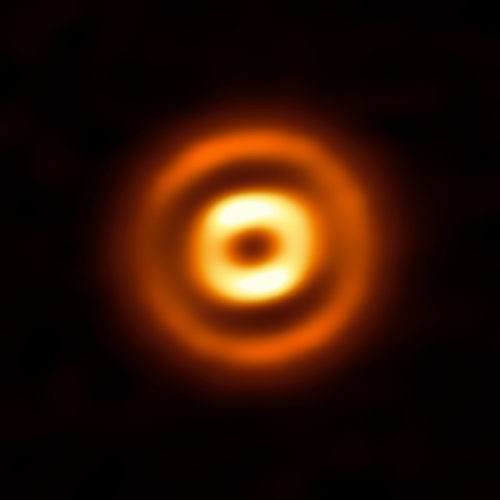
The HD 169142 system (Image ALMA (ESO/NAOJ/NRAO)/ Fedele et al.)

An article published in the journal “Astronomy & Astrophysics” describes the discovery of traces of two planets that are forming in the young system HD 169142. A team of researchers led by Davide Fedele of the Institute of Astrophysics in Florence, Italy, used the ALMA radio telescope to study the of gas and dust disk surrounding the young star identifying gap rings compatible with the formation of planets similar to Jupiter.

Artist's concept comparing Mars as it is today and as it was 4 billion years ago (Image NASA’s Goddard Space Flight Center)

An article published in the journal “Science” describes a research on the atmosphere of the planet Mars that indicates the Sun’s wind and radiation as the principal culprits of the fact that today that atmosphere is so thin. A team led by Bruce Jakosky, principal investigator of NASA’s MAVEN space probe’s mission, examined the measurements of the existing gases estimating for example that 65% of argon present origininally got lost in space. This research confirms the one published in November 2015.