
Planets

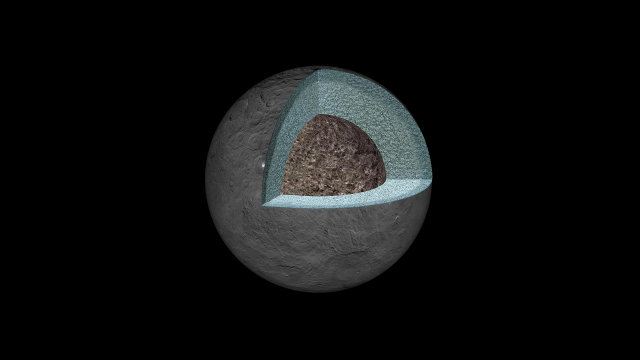
Artistic representation of Ceres' possible internal layers (Image NASA/JPL-Caltech/UCLA/MPS/DLR/IDA)

An article published in the journal “Nature” describes a research about the internal structure of the dwarf planet Ceres. A team led by Ryan Park of NASA’s Jet Propulsion Laboratory (JPL) analyzed very precisely the movements of the Dawn space probe, which is orbiting Ceres, to get clues that suggest that it’s composed of a number of layers with the densest in its core and some weak layers that include ice water.

Artistic representation of Io with its volcanoes and the atmosphere collapsing when it enters Jupiter's shadow (Image SwRI/Andrew Blanchard)

An article published in the “Journal of Geophysical Research” describes a research funded by NASA on the atmosphere of Io, one of the “Galilean” moons of Jupiter. A group of scientists led by Constantine Tsang of the Southwest Research Institute detected the changes taking place in the atmosphere of Io, noting how it collapses when it enters Jupiter’s shadow and the temperature drops.

Visible (on the left) and topographic (on the right) map of the dwarf planet Ceres (Image NASA/JPL-Caltech/SwRI)

An article published in the journal “Nature Communications” describes a research on the craters found on the surface of the dwarf planet Ceres by NASA’s Dawn space probe. A team of scientists led by Simone Marchi of the Southwest Research Institute in Boulder argues that there are fewer large craters than expected and the reason is that were obliterated.

View of Mawrth Vallis (Image ESA/DLR/FU Berlin, CC BY-SA 3.0 IGO)

The German space agency DLR has published new photographs of Mawrth Vallis, a large valley on Mars where there are traces of the ancient presence of liquid water. It’s not a surprise because for years scientists have known the presence of phyllosilicates, clay minerals that can only exist where there was water. A view created using a mosaic of nine imagine taken by ESA’s Mars Express space probe’s HRSC instrument shows Mawrth Vallis in all its glory.

Artistic concept of two exoplanets transiting in front of the TRAPPIST-1 star (Image NASA/ESA/STScI/J. de Wit (MIT))

An article published in the journal “Nature” describes a research on two exoplanets of the TRAPPIST-1 system. A group of researchers led by Julien de Wit of the Massachusetts Institute of Technology in Cambridge, Massachusetts used the Hubble and Spitzer space telescopes to better examine two of the three exoplanets whose discovery was announced in May 2016.