Planets

Electrons (in red) attract positive ions (in blue) pushing them out of the atmosphere (Image ESA–C. Carreau)

An article published in the journal “Geophysical Research Letters” describes the discovery of an electric wind on Venus that accelerates the ionized hydrogen and oxygen atoms that make up water molecules at such a speed that they disperse in space. A team of scientists led by Glyn Collinson, a scientist of NASA’s Goddard Space Flight Center, analyzed data from the ASPERA-4 instrument of ESA’s Venus Express space probe to find out this wind generated by Venus’ electric field.

Charon, Nyx and Hydra (Image NASA/JHUAPL/SwRI)

NASA has published a comparative analysis of the spectral measurements of three moons of the dwarf planet Pluto which prove that in particular Nyx but also Hydra have a surface covered in water ice. The New Horizons space probe’s LEISA instrument carried out the measurements during the July 14, 2015 flyby. Unfortunately the location of the other two small moons, Styx and Kerberos in those hours didn’t allow spectral measurements.

Artist's impression of the simultaneous stellar eclipse with the planetary transit events by Kepler-1647b (Image Lynette Cook)

An article published in “The Astrophysical Journal” describes the study of the planet’s characteristics circumbinary Kepler-1647b. By using the Kepler space telescope NASA, a team of scientists at NASA’s Goddard Space Flight Center and the San Diego State University led by Veselin Kostov discovered this planet that orbits two stars. This is not the first case of this kind but it’s the biggest and its year is longer, about three Earth’s years.

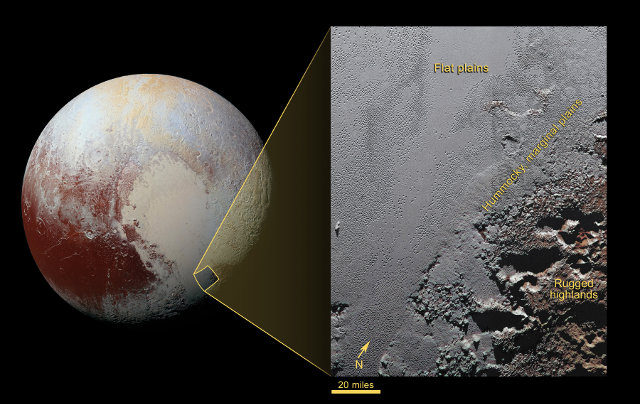
Krun Macula, the borders of Sputnik Planum and their place on Pluto (Image NASA/JHUAPL/SwRI)

NASA released an image of an area of ​​Pluto informally called Krun Macula that shows the variability on the dwarf planet. Obtained by putting together various photographs taken by NASA’s New Horizons space probe during its July 14, 2015 flyby, it shows the border area between the icy plains of the heart-shaped region and the nearby highlands.

Illustration of a hot Jupiter planet with its clouds (Image NASA/JPL-Caltech)

An article published in “The Astrophysical Journal” describes a research about the possible presence of water in the planets of the type called hot Jupiter. Those are gas giants just like Jupiter but orbit very close to their stars and consequently have very high surface temperatures. A team of scientists at NASA’s JPL led by Aishwarya Iyer tried to understand why the atmosphere of some hot Jupiters doesn’t seem to contain water.