Planets

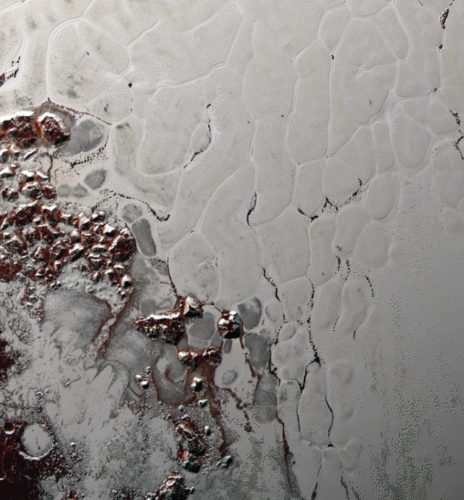
An area about 400 km (250 miles) long in Pluto's Sputnik Planum region (Image NASA/JHUAPL/SwRI)

Two articles published in the journal “Nature” describe a research about the heart-shaped geological formation on the dwarf planet Pluto. NASA’s New Horizons mission scientists determined various characteristics of the area, informally called Sputnik Planum, explaining that a phenomenon called convection renews its surface over time. Using the images taken by the New Horizons space probe, another research revealed new details on Pluto’s atmosphere.

Representation of a solar superflare (Image NASA's Goddard Space Flight Center, Greenbelt, Md.)

An article published in the journal “Nature Geoscience” describes a study on the relationship between super solar flares of a few billion years ago and the emergence of life forms on Earth. According to a team of NASA scientists led by Vladimir Airapetian those gigantic storms provided the energy needed to warm up the Earth and to trigger some chemical reactions needed to form complex molecules such as RNA and DNA on which life is based.

The area that includes Chryse Planitia, Acidalia Planitia and Arabia Terra (a,c) with the close-up of a promontory (c) (Image J. Alexis Palmero Rodriguez)

An article published in the journal “Nature” presents a study that describes two possible mega-tsunamis that shook the surface of the planet Mars more than three billion years ago. According to a team led by J. Alexis Palmero Rodriguez of the Planetary Science Institute two meteorites hit Mars a few million years from each other but with similar effects. Perhaps at that time there was an ocean of liquid water and the impacts raised waves up to 120 meters (almost 400 fett) which engulfed large areas of the mainland.

Artistic representation of the biggest dwarf planets in the solar system (Image Konkoly Observatory/András Pál, Hungarian Astronomical Association/Iván Éder, NASA/JHUAPL/SwRI)

An article published in “The Astronomical Journal” describes a research on a trans-Neptunian object called 2007 OR10. A team of astronomers used NASA’s Kepler space telescope and archive data of ESA’s Herschel space telescope’s observations to study this celestial body. The result is that they discovered that it’s much bigger than it looked and is probably a dwarf planet.