Planets

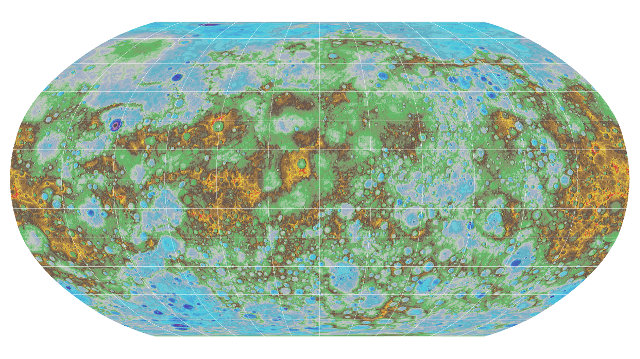
Topographic map of the planet Mercury (Image USGS)

NASA’s MESSENGER mission has published the first complete topographical map of the planet Mercury. To be precise, it’s a Digital Elevation Model (DEM), a representation of the elevation distribution of territory, or of another surface, in digital format. It’s the product of the processing of data collected by the MESSENGER space probe during its mission ended just over a year ago.

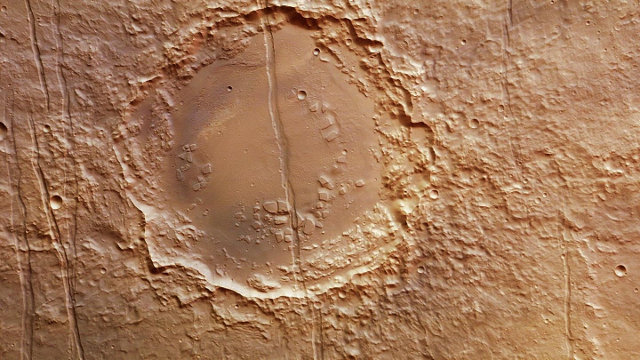
Crater in Memnonia Fossae (Image DLR)

The German space agency DLR published photos of a curious crater marked by a deep rift that splits it in two in the area of ​​Mars called Memnonia Fossae. These are photos taken by the High Resolution Stereo Camera (HRSC), one of the instruments of ESA’s Mars Express space probe.

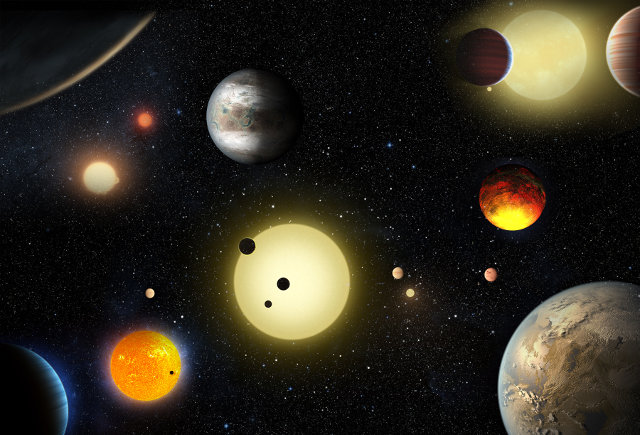
Artistic representation of the TRAPPIST-1 system with its planets seen from one of them (Image ESO/M. Kornmesser)

An article published in the journal “Nature” describes the discovery of a solar system with three rocky planets that orbit the star TRAPPIST-1, a really small ultra-cool dwarf. A team led by Michaël Gillon of the Institut d’Astrophysique et Géophysique at the University of Liège in Belgium, found these planets with sizes and surface temperatures similar to those of the Earth using the TRAPPIST telescope at ESO’s La Silla Observatory in Chile.

The dwarf planet Makemake seen by the Hubble Space Telescope with its moon indicated by the arrow (Image NASA, ESA, and A. Parker and M. Buie (SwRI))

The Hubble Space Telescope has identified a moon of the dwarf planet Makemake. For the moment it was simply designated S/2015 (136472) and nicknamed MK2 and it’s a small moon with an estimated diameter of about 160 kilometers (about 100 miles). The discovery came from observations made in April 2015 using the Hubble’s Wide Field Camera 3 instrument.