Planets

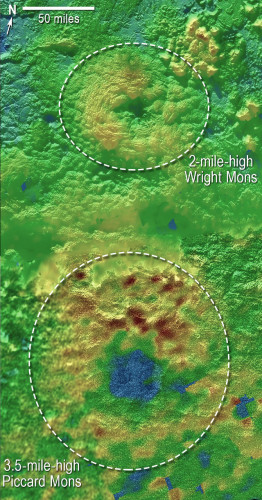
3-D topographic mapsWright Mons and Piccard Mons, the possible cryovolcanoes. The color depicts changes in elevation, blue indicating lower terrain and brown showing higher elevation. Green terrains are at intermediate heights (Image NASA/JHUAPL/SwRI)

NASA’s New Horizons mission team is presenting the latest findings on the dwarf planet Pluto at the 47th Annual Meeting of the American Astronomical Society’s Division for Planetary Sciences in National Harbor, Maryland. The data collected by the spacecraft during its July 14, 2015 flyby made it possible to identify possible cryovolcanoes. Data on small moons of Pluto are limited but suggest more and more that at least Cerberus and Hydra are the result of the merger of two or more asteroids.

Locations of 19 auroral detections (white circles) on Mars The data is superimposed on the magnetic field line structure where red indicates closed magnetic field lines, grading through yellow, green and blue to open field lines in purple (Image based on data from J-C. Gérard et al (2015))

Two articles, one published in “Journal of Geophysical Research: Space Physics” and one published in the journal “Icarus”, describe a research on ultraviolet auroras detected on Mars by ESA’s Mars Express space probe. Jean-Claude Gérard and Lauriane Soret of the University of Liege, Belgium, led a team of scientists who examined ten years of data that were analyzed to understand the mechanisms of creation of these auroras.

Artistic representazion of a solar storm stripping gas from Mars atmosphere (Image NASA/GSFC)

Two magazines host a number of articles describing the results of a year of the mission of NASA’s MAVEN space probe, “Science” and “Geophysical Research Letters”. The conclusions about why Mars lost most of its atmosphere were also explained in a NASA press conference held yesterday. Simply put, it was solar wind, which could take away the atmosphere thanks to the absence of a protective magnetic field transforming a planet that was originally similar to Earth in the desolate red planet we know today.

Artist's impression of innumerable Earth-like planets that have yet to be born (Image NASA, ESA, and G. Bacon (STScI))

An article just published in the journal “Monthly Notices of the Royal Astronomical Society” describes a research on the history and future of the formation of Earth-like planets. A team led by Peter Behroozi of the Space Telescope Science Institute (STScI) used data collected by the Hubble and Kepler space telescopes to evaluate the rate of formation of the Earth-like planets. The conclusion is that only 8% of potentially habitable planets existed at the birth of our solar system.

Picture of Mangala Valles on Mars taken by ESA's Mars Express space probe (Photo ESA/DLR/FU Berlin)

The analysis of photographs of the region of Mars known as Mangala Valles led to the conclusion that it was volcanic activity that generated the heat that caused catastrophic floods through the melting of glaciers. The photographs were taken by ESA’s Mars Express space probe on July 12, 2015 just south of the valley known as Minio Vallis, a part of the canal system of Mangala Valles, near the equator in the western hemisphere of the red planet.