Roscosmos

Nauka/MLM blasting off atop a Proton-M rocket (Image NASA TV)

Yesterday, the Russian Nauka module, formally called the Multipurpose Laboratory Module (MLM), was launched atop a Proton-M rocket from the Kazakh cosmodrome of Baikonur. After about nine minutes it successfully separated from the rocket’s last stage and set off on its course. Its journey will take about 8 days to reach the International Space Station on July 29, where it will become part of the Russian section many years behind schedule. The launch included the European Robotic Arm (ERA) developed under the auspices of ESA, a robotic arm that will be used for operations in the area of ​​the Station’s Russian section.

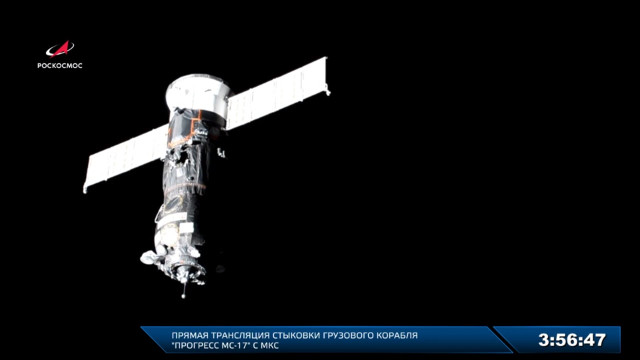
The Progress MS-17 cargo spacecraft approaching the International Space Station (Image courtesy Roscosmos)

A few hours ago, the Progress MS-17 spacecraft docked with the International Space Station in the mission also referred to as Progress 78 or 778. The Russian cargo spacecraft, which blasted off last Tuesday, June 30, carries food, water, scientific experiments, fuel, and various hardware.

The Progress MS-17 cargo spacecraft docked with the International Space Station’s Russian Poisk module. Today, the crew will probably proceed with the hatch opening and the procedures to make the Progress MS-17 an appendage to the Station.

The Progress MS-17 cargo spacecraft blasting off atop a Soyuz-2.1a rocket (Image NASA TV)

A few hours ago, the Progress MS-17 spacecraft blasted off atop a Soyuz-2.1a rocket from the Baikonur Cosmodrome in Kazakhstan. After about nine minutes it successfully separated from the rocket’s last stage and was placed on its route. The cargo spacecraft began its resupply mission to the International Space Station also called Progress 78 or 78P. In this mission, the route used is the one that requires about two days.

Kate Rubins, Sergey Ryzhikov, Sergey Kud-Sverchkov, and the crew that assisted them after their landing (Photo NASA/Bill Ingalls)

A few hours ago, astronaut Kate Rubins and cosmonauts Sergey Ryzhikov and Sergey Kud-Sverchkov returned to Earth on the Soyuz MS-17 spacecraft, that landed in Kazakhstan. The three of them spent a bit more than 6 months on the International Space Station, where they arrived on October 20, 2020, as part of Expedition 63. After landing, they were assisted by a skeleton crew with the precautions needed to avoid the risk of Covid-19 infection.