Roscosmos

The Soyuz MS-14 spacecraft during its docking attempt (Image NASA)

A few hours ago the Soyuz MS-14 spacecraft, which blasted off about two days ago from the Baikonur Cosmodrome in Kazakhstan, attempted to dock with the International Space Station but a communications problem forced to abort the maneuver. Cosmonauts Alexey Ovchinin and Alexander Skvortsov are working together with the Russian space agency Roscosmos to retry the docking on Monday while the Soyuz MS-14 remains at a safe distance.

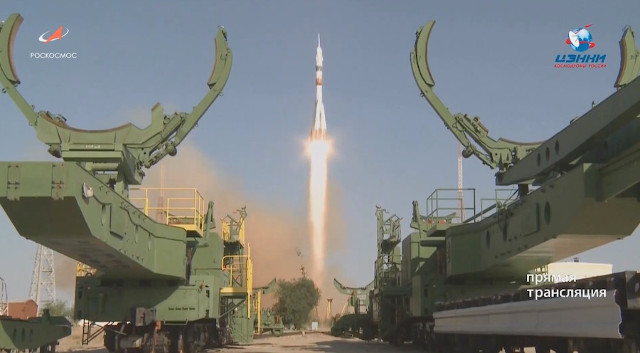
The Progress MS-12 cargo spacecraft approaching the International Space Station (Image NASA TV)

A few hours ago the Progress MS-12 spacecraft blasted off atop a Soyuz 2.1a rocket from the Baikonur Cosmodrome in Kazakhstan. After about nine minutes it successfully separated from the rocket’s last stage and was placed on its ultra-fast track in its resupply mission to the International Space Station also called Progress 73 or 73P. After almost 3.5 hours it reached the International Space Station docking with its Pirs module.

The Spektr-RG space telescope blasting off atop a Proton rocket (Image courtesy Roscosmos)

A little more than two hours ago, the Spektr-RG space telescope was launched on a Proton rocket from the Baikonur Cosmodrome, Kazakhstan. After about two hours it separated from the rocket’s upper stage to head towards the L2 Lagrangian point, about 1.5 million kilometers from Earth.

The Spektr-RG (Spektr-Roentgen Gamma, SRG) space telescope is a project born from a collaboration of the Russian Roscosmos and German DLR space agencies for the observation of the X-ray sky. This type of astronomy got a bit crippled by the very premature end of the Japanese Hitomi mission while ESA’s XMM-Newton and NASA’s Chandra space telescopes are still active but these are missions that started twenty years ago.