Roscosmos

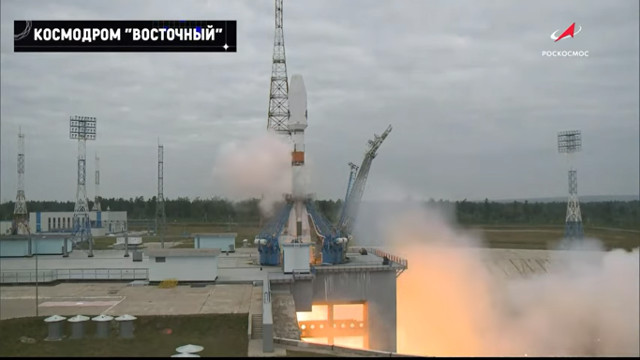
The Luna 25 lander blasting off atop a Soyuz-2.1b (Image courtesy Roscosmos)

A few hours ago, the Luna 25 lander blasted off atop a Soyuz-2.1b rocket from the Russian Vostochny Cosmodrome. After about an hour, the Fregat-M last stage pushed the vehicle to leave Earth orbit, performing the maneuver called in jargon TLI (Tras Lunar Injection) which will take it towards the Moon, where it will land near the south pole, near the Boguslavsky crater.

The Luna 25 mission is the first of the Luna-Glob program, which began in the 1990s with the ambition to reprise the Soviet Luna program and develop it in a way that wasn’t possible in the 1970s. For this reason, the name is Luna 25, considering it the follow-up mission to the 1976 Luna 24.

The Progress MS-23 cargo spacecraft approaching the International Space Station (Image NASA TV)

A few hours ago, the Progress MS-23 spacecraft blasted off atop a Soyuz 2.1a rocket from the Baikonur Cosmodrome in Kazakhstan. After about nine minutes it successfully separated from the rocket’s last stage and was placed on its ultra-fast track in its resupply mission to the International Space Station also called Progress 84 or 84P. After almost 3.5 hours it reached the International Space Station docking with its Poisk module. The ultra-fast track requires very precise maneuvering and a favorable position of the Station. For this reason, it wasn’t used in the previous two Russian resupply missions.

The Soyuz MS-22 spacecraft departing the International Space Station (Image NASA TV)

A little while ago, the Soyuz MS-22 spacecraft landed in Kazakhstan after departing the International Space Station almost two hours earlier. Generally, the staff arrives shortly after to assist the crew who have just returned from the Station but in this case, there’s no one on board due to the problems encountered in December 2022 with the cooling system, which made the journey unsafe for the humans.

The Crew Dragon Endurance spacecraft concludes its Crew-5 mission with its splashdown (Image NASA TV)

A few hours ago, SpaceX’s Crew Dragon Endurance spacecraft concluded its Crew-5, or SpaceX Crew-5, mission for NASA by landing without problems. On board were astronauts Nicole Mann, Josh Cassada, and Koichi Wakata and cosmonaut Anna Kikina, who had reached the International Space Station on October 6, 2022, and were part of Expedition 68. The four of them finished the fifth regular crewed mission of SpaceX in the Atlantic Ocean, off the coast of Tampa, Florida. The Crew Dragon departed the Station about nineteen hours earlier.

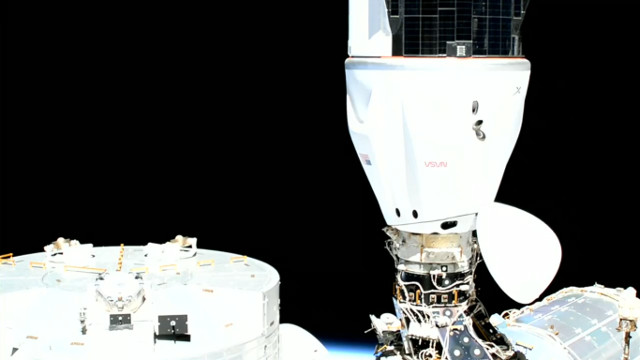
SpaceX's Crew Dragon Endeavour spacecraft docked with the International Space Station (Image NASA TV)

A few hours ago, SpaceX’s Crew Dragon Endeavour spacecraft docked with the Harmony module of the International Space Station completing the first part of its Crew-6 or SpaceX Crew-6 mission that began with its launch a little more than 24 hours earlier. After checking that the pressure was properly balanced, the hatch was opened to allow Andrey Fedyaev, Stephen Bowen, Warren Hoburg, and Sultan Alneyadi to enter the Station and start their mission, which will last about six months.