SpaceX

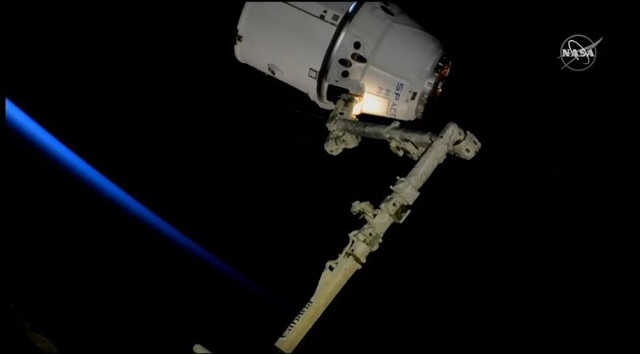
The Dragon cargo spacecraft departing International Space Station to end its CRS-20 mission (Image NASA TV)

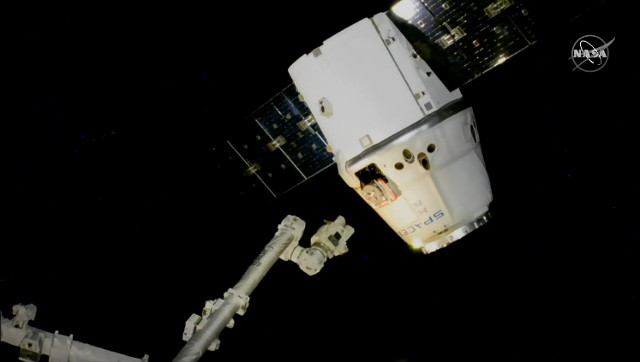
A few hours ago the SpaceX Dragon spacecraft ended its CRS-20 (Cargo Resupply Service 20) mission for NASA splashing down smoothly in the Pacific Ocean a bit more than 800 kilometers (about 500 miles) off the coast of California. The Dragon left the International Space Station yesterday. For SpaceX, this is the conclusion of the first contract with NASA to transport resupplies to the Station with the first version of the Dragon cargo spacecraft.

Shortly after landing, SpaceX boats went to retrieve the Dragon to transport it to the coast. The cargo brought back to Earth will be delivered to NASA soon, probably tomorrow. The Dragon spacecraft reached the International Space Station on March 9, 2020.

Artist's concept of the Dragon XL cargo spacecraft after separating from the Falcon Heavy rocket's second stage (Image courtesy SpaceX)

NASA has announced that it has selected SpaceX as the first supplier in the Gateway Logistics Services contract to transport cargo, experiments and other supplies to the Lunar Gateway, part of the Artemis program that aims to bring astronauts back to the Moon. At least two missions will be carried out with the Dragon XL cargo spacecraft, a new variant of the Dragon 2 cargo optimized to carry over 5 metric tons of cargo to the Moon’s orbit. The timeline for these missions isn’t clear due to the NASA’s changes of plans, as recently the agency decided to skip the use of the Lunar Gateway for the mission that’s supposed to take place by 2024 and use it in the following years.

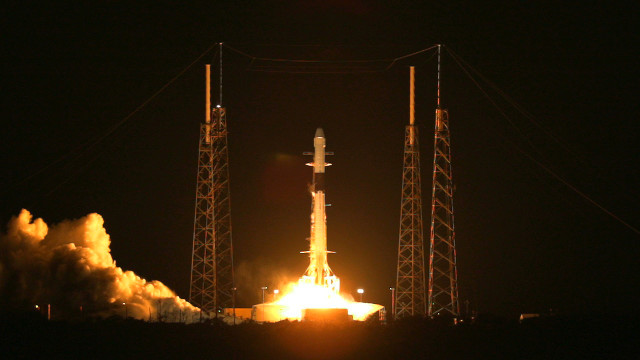
The Dragon cargo spacecraft blasting off for its CRS-20 mission atop a Falcon 9 rocket (Photo NASA)

A few hours ago the SpaceX Dragon spacecraft blasted off atop a Falcon 9 rocket from Cape Canaveral in its CRS-20 (Cargo Resupply Service 20) mission, also referred to as SPX-20. After just over ten minutes it separated successfully from the rocket’s last stage and went en route. This is the 20th mission for the Dragon spacecraft to resupply the International Space Station with various cargoes and then return to Earth, again with various cargoes. It’s the last mission for this Dragon version, which will be replaced by Dragon 2 from the next mission.

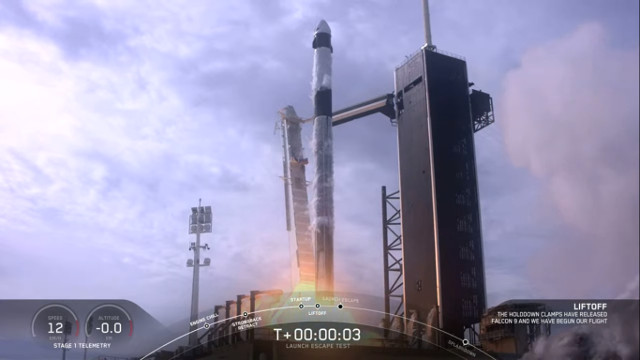
La navicella spaziale Crew Dragon al decollo per il test di interruzione d'emergenza del lancio (Immagine cortesia SpaceX)

SpaceX has just completed the In-Flight Abort Test of one of its Crew Dragon spacecraft, the version of Dragon 2 produced for the transport of astronauts. A Falcon 9 rocket was deliberately blown up at the moment of maximum dynamic pressure, Max q in jargon, to test that the the systems which in a normal launch are used to rescue the crew aboard the Crew Dragon work properly.