SpaceX

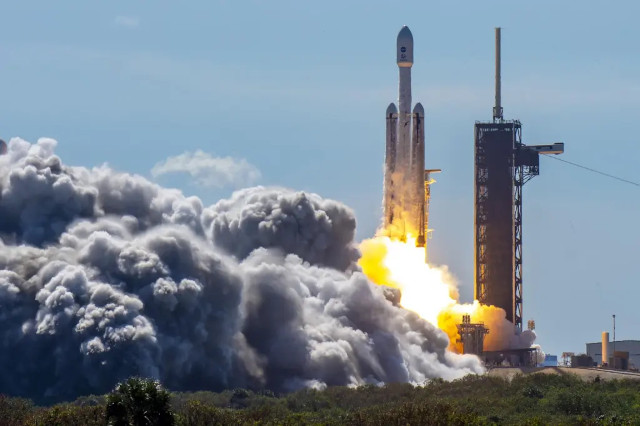
NASA's Europa Clipper space probe blasting off atop a SpaceX Falcon Heavy rocket (Photo NASA)

A few hours ago, NASA’s Europa Clipper space probe blasted off atop a SpaceX Falcon Heavy rocket from the Kennedy Space Center. After just over an hour, it successfully separated from the rocket’s last stage and set off on its route that will take it into deep space, to Europa, Jupiter’s moon with an icy surface that hides an ocean of liquid water to understand if it’s habitable.

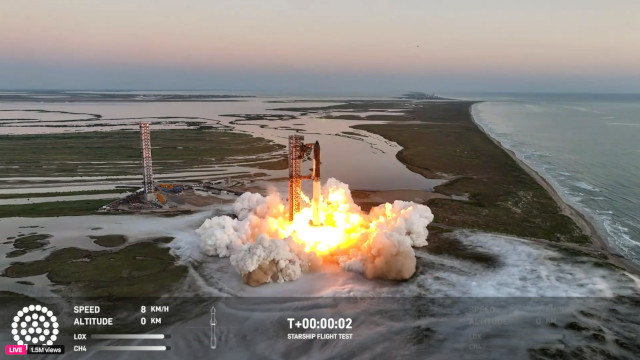
Super Heavy 12 and Starship 30 blasting off (Image courtesy SpaceX)

SpaceX conducted a new flight test of its Super Heavy rocket and Starship prototypes, launched from its base in Boca Chica, Texas. This is the fifth test involving the entire system of Elon Musk’s company which is supposed to revolutionize space travel with an unprecedented transport capacity and being totally reusable. They are advanced prototypes with the Super Heavy identified as Booster 12 and the Starship identified as Starship 30 or Ship30 or simply S30.

Each test leads to new changes to the vehicles’ systems, and this was also true after the fourth test conducted on June 6, 2024. The scheduled breakthrough was in the test of the system called Mechazilla, the structure attached to the launch pad that also has the purpose of capturing the Super Heavy when it returns after launching the Starship.

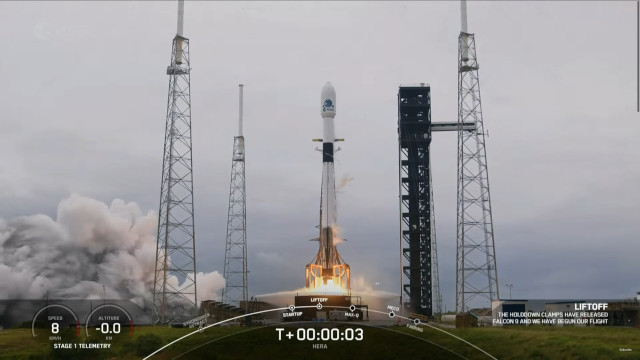
The Hera space probe blasting off atop a Falcon 9 rocket (Image courtesy SpaceX)

Yesterday, ESA’s Hera space probe blasted off atop a SpaceX Falcon 9 rocket from the Cape Canaveral together with the two nanosatellites Juventas and Milani. After about 76 minutes, it successfully separated from the rocket’s last stage and set on its course which in almost exactly two years will take it to the asteroid Didymos and its moon Dimorphos to examine the consequences of the impact of NASA’s DART spacecraft.

The Crew Dragon Freedom spacecraft docked with the International Space Station in its Crew-9 mission (NASA TV)

A few hours ago, SpaceX’s Crew Dragon Freedom spacecraft docked with the Harmony module of the International Space Station completing the first part of its Crew-9 or SpaceX Crew-9 mission that began with its launch about 28 hours earlier. After checking that the pressure gets properly balanced, the hatch will be opened to allow Nick Hague and Aleksandr Gorbunov to enter the Station and start their mission, which will last about five months.

The Crew Dragon Resilience spacecraft ends its Polaris Dawn mission splashing down (Image courtesy SpaceX)

A little while ago, SpaceX’s Crew Dragon Resilience spacecraft concluded its Polaris Dawn mission splashing down without problems. Onboard were Jared Isaacman, Sarah Gillis, Anna Menon, and Scott Poteet, who finished this completely private space mission in the Gulf of Mexico. Shortly after the splashdown, the SpaceX ship went to retrieve the Crew Dragon and its crew to transport them to the coast.