Stars

Blogs about stars

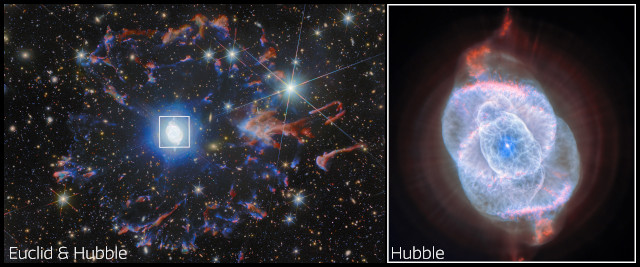
On the left, a combination of photos of the planetary nebula NGC 6543 obtained by the Euclid and Hubble space telescopes with a detail from a photo obtained by Hubble on the right.

The planetary nebula NGC 6543, also known with the nickname Cat’s Eye, is the protagonist of the Hubble Space Telescope’s photo of the month. However, for this occasion, a juxtaposition was created between an image captured by Hubble and one captured by ESA’s Euclid Space Telescope. These two instruments can both capture wavelengths in the near-infrared and visible light, but Euclid specializes in deep-field surveys. For this reason, it portrayed NGC 6543 as part of a large region of space. The combination of the two telescopes offers greater detail on a planetary nebula that has been studied for over two centuries.

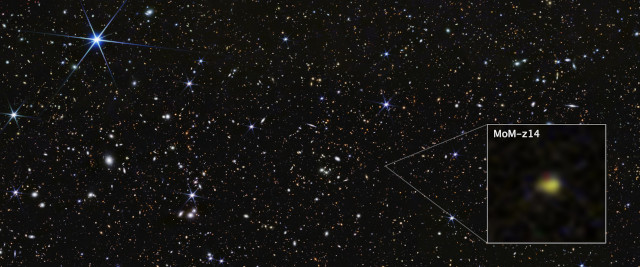
The galaxy MoM-z14 photographed by the James Webb Space Telescope's NIRCam (Near-Infrared Camera) instrument with an image from the so-called COSMOS Legacy Field in the background.

An article accepted for publication in the “Open Journal of Astrophysics” reports evidence that the galaxy MoM-z14 is the most distant known so far. A team of researchers led by the Kavli Institute for Astrophysics and Space Research at the Massachusetts Institute of Technology (MIT) used the James Webb Space Telescope as part of the “Mirage or Miracle” (MoM) survey, in which the NIRSpec instrument was used to verify the nature of very bright and potentially very distant galaxies observed in images captured by the NIRCam instrument. The results confirm that we see MoM-z14 as it was about 280 million years after the Big Bang, confirming again that highly active galaxies existed at that time.

A graph with the conservative habitable zone illustrated by the orange band and ellipses illustrating the extended habitable zone proposed by this study

An article published in “The Astrophysical Journal” reports the results of a study on the habitable zone that goes beyond the so-called conservative zone because it’s based on rigid assumptions. Astrophysicist Amri Wandel of the Hebrew University of Jerusalem focused on examining the conditions existing in systems of low-mass stars: orange dwarfs (K-class stars) and red dwarfs (M-class stars). The study specifically considered planets tidally locked to their stars.

Amri Wandel conducted an analysis using climate models that account for global heat transport, the greenhouse effect, and albedo. This led him to conclude that these stars may host planets potentially habitable for Earth-like life forms orbiting outside the conservative habitable zone.

The complete map obtained thanks to the SPHEREx space telescope, with infrared emissions generated mainly by dust (red) and hot gas (blue), key ingredients in the formation of new stars and planets

NASA has published the first cosmic map generated using observations from its SPHEREx space telescope. In particular, these observations include 102 wavelengths in the near-infrared. What NASA has defined as 102 colors offer a wealth of different information about the observed objects, valuable in a variety of cosmological studies. The wealth of information is such that NASA treats them as if they had obtained 102 different maps.

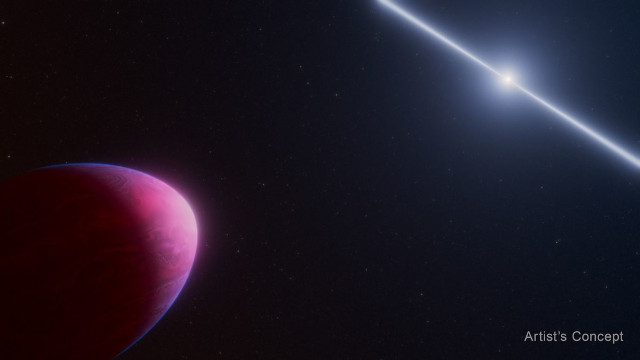
Artist's concept of the of the exoplanet PSR J2322-2650b and its pulsar (Image NASA, ESA, CSA, Ralf Crawford (STScI))

An article published in The Astrophysical Journal Letters reports the results of a study of a gas giant exoplanet cataloged as PSR J2322-2650b, which has a completely abnormal atmosphere composed above all of helium and carbon. A team of researchers used observations conducted with the James Webb Space Telescope to study the atmosphere of this exoplanet, which has a mass similar to Jupiter’s and has a distance from its star that is only one-hundredth of the Earth’s distance from the Sun. The star is a pulsar, adding another unusual element to the system. PSR J2322-2650b can’t be explained by current models of planetary formation.