Stars

Artist's impression of the X9 system with the view from Chandra X-ray Observatory in the inset (Image X-ray: NASA/CXC/University of Alberta/A.Bahramian et al.; Illustration: NASA/CXC/M.Weiss)

An article published in the journal “Monthly Notices of the Royal Astronomical Society” describes a research on what appears to be a binary system including a star with the closest orbit around a black hole. A team of astronomers used NASA’s Chandra X-ray Observatory and NuSTAR space Telescope and the Australia Telescope Compact Array (ATCA) to observe this system called X9 concluding that the star, a white dwarf, takes 28 minutes to orbit the black hole.

A HSC-SSP image of a galaxy cluster (Image NAOJ/HSC Project)

At the end of February the first data from the Hyper Suprime-Cam Subaru Strategic Program (HSC-SSP) were released to the public. It’s a kind of cosmic census created using a large digital camera installed on the Subaru Telescope. The National Astronomical Observatory of Japan (NAOJ) developed a dedicated database and interface to use the wealth of data collected. One hope is to be closer to understand the fate of the universe.

Artistic concept of the galaxy A2744_YD4 (Image ESO/M. Kornmesser)

An article to be published in the journal “The Astrophysical Journal Letters” describes a research about the galaxy A2744_YD4, the most distant observed with the ALMA radio telescope. A team of astronomers led by Nicolas Laporte of University College London also used the X-shooter instrument on ESO’s VLT to confirm that we’re seeing A2744_YD4 as it was about six hundred million years after the Big Bang. The most interesting thing is the dust detection indicating that there were already several supernovae.

Protoplanetary disk with a dust trap seen as a bright ring (Image courtesy Jean-Francois Gonzalez)

An article published in the journal “Monthly Notices of the Royal Astronomical Society” describes a research that provides an explanation for one of the last remaining mysteries about planet formation. An international team of researchers conducted a series of simulations that show that in the protoplanetary disk around a young star dust traps form that accelerate the aggregation of pebble-sized fragments from which planets are born.

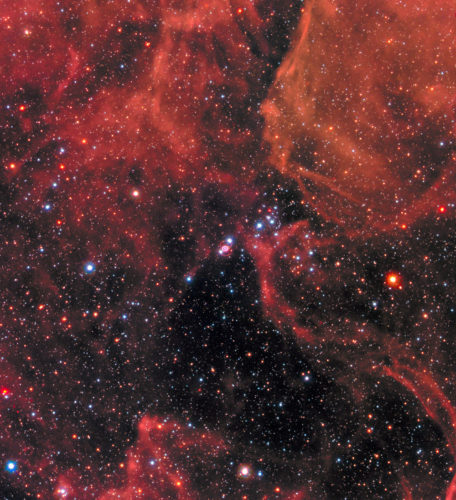
The supernova SN 1987A at the center (Image NASA, ESA, R. Kirshner (Harvard-Smithsonian Center for Astrophysics and Gordon and Betty Moore Foundation), and M. Mutchler and R. Avila (STScI))

In recent days on La Réunion Island a meeting was held to celebrate the 30th anniversary of the sighting of the supernova 1987A (SN 1987A), the brightest of the last four centuries and for this reason a historic event for modern astronomy. For these celebrations scientists from the Hubble and Chandra space telescopes chose an animation derived from the model of a team of astrophysicists from INAF-Osservatorio Astronomico di Palermo, Italy led by Salvatore Orlando.