Stars

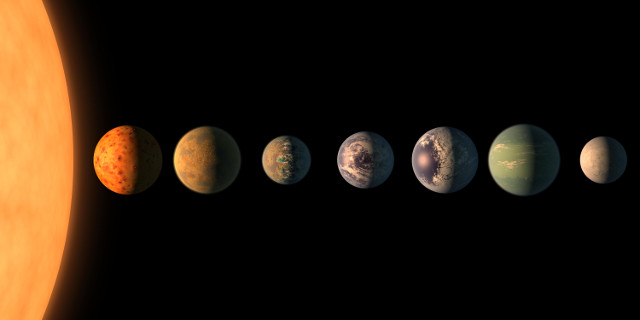
Artistic concept of the planets in the TRAPPIST-1 system (Image NASA/JPL-Caltech)

NASA held a press conference to communicate new discoveries in the research on the TRAPPIST-1 star system. These results have also been described in an article published in the journal “Nature”. Using data collected by NASA’s Spitzer Telescope, a team of researchers led by Michaël Gillon of the STAR Institute confirmed the existence of 7 planets in this system, all rocky. Potentially, at least in some region of all those planets there could be liquid water.

The Magellanic Clouds (Image V Belokurov, D Erkal, A Mellinger)

An article published in the journal “Monthly Notices of the Royal Astronomical Society” describes the evidence gathered of the existence of a bridge of stars between the two Magellanic Clouds, the two dwarf galaxies satellite of the Milky Way. An international team led by astronomers from the University of Cambridge used data collected by ESA’s Gaia space probe to determine that the bridge is composed not only of gas but also of stars that are old and were stripped from their galaxies.

The Sun during a solar flare (Image NASA/NOAA)

NASA released an image of the solar flare occurred on January 21 captured by the GOES-16 satellite that the agency runs with NOAA using the Extreme Ultraviolet and X-Ray Irradiance Sensors (EXIS) instrument. It’s specifically aimed to observe the Sun and monitor phenomena such as solar storms, which can have consequences on the activity of satellites but also of power plants and other human activities.

Artist’s impression of the AR Scorpii system (Image M. Garlick/University of Warwick/ESO)

An article published in the journal “Nature Astronomy” describes the discovery of the first white dwarf pulsar, an object so far only hypothesized but never found. A team of researchers from the British University of Warwick identified it in the AR Scorpii (AR Sco) System, composed of a red dwarf and the white dwarf pulsar that a rotation period of just under two minutes.

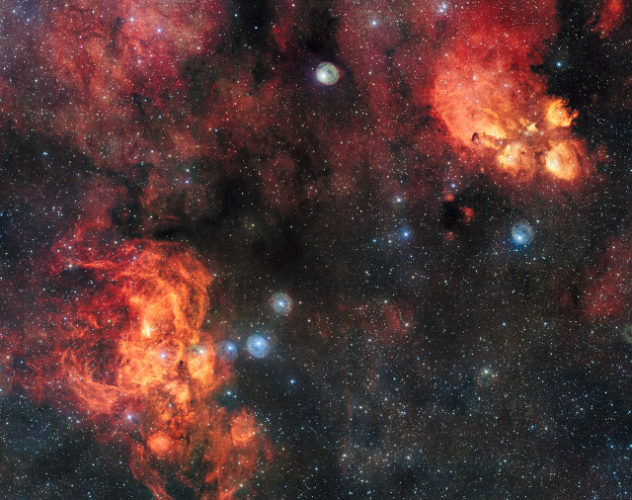
NGC 6334 and NGC 6357 (Image ESO)

ESO has released one of the largest astronomical images created thanks to the VST (Very Large Telescope Survey Telescope) which includes two cosmic clouds of gas and dust, NGC 6334 and NGC 6357. Because of their shapes, they’re also known respectively with their popular names as the “Cat’s Paw Nebula” and the “Lobster Nebula”.