
Stars

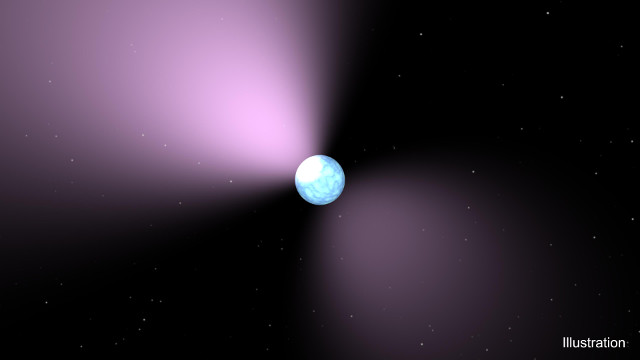
Artist's concept of a neutron star (Image NASA/JPL-Caltech)

An article published in “Astrophysical Journal Letters” describes a research, also presented recently at the meeting of the American Astronomical Society, about the pulsar known as PSR J1119-6127. Discovered over 16 years ago, recently it showed behaviors typical of a magnetar, a different type of neutron star. This oddity might help explain the link between pulsars and magnetars and the evolution of neutron stars.

Global view of the Orion A molecular cloud (Image ESO/VISION survey)

An article published in the journal “Astronomy & Astrophysics” describes the most detailed view of the molecular cloud called Orion A, one of the two giant molecular clouds in the Orion molecular cloud complex. A team of researchers created it by putting together infrared images obtained from the VISION (Vienna Survey in Orion) survey with ESO’s VISTA telescope revealing many young stars and other objects normally hidden within dust clouds.

The nebula NGC 6357 (Image X-ray: NASA/CXC/PSU/L. Townsley et al; Optical: UKIRT; Infrared: NASA/JPL-Caltech)

NASA has released an image that’s stunning even by its standards of nebula NGC 6357. The colors are the result of a composition obtained by putting together X-ray data from Chandra X-ray Observatory and the ROSAT space telescope, the infrared data from NASA’s Spitzer space telescope and optical data from the SuperCosmos Sky Survey.

Possible Proxima Centauri orbit. The numbers are in millennia (Image P. Kervella (CNRS/U. of Chile/Observatoire de Paris/LESIA), ESO/Digitized Sky Survey 2, D. De Martin/M. Zamani)

An article published in the journal “Astronomy and Astrophysics” describes the observations that led to conclude that the star Proxima Centauri orbits Alpha Centauri A and B forming a triple system. Astronomers Pierre Kervella, Frederic Thevenin and Christophe Lovis used the HARPS instrument installed at ESO’s La Silla observatory in Chile to obtain the precise measurements needed to support this theory.

Some of the ancient galaxies observed (Image K. Trisupatsilp, NRAO/AUI/NSF, NASA)

An article published in “The Astrophysical Journal” describes the observations of the birthplaces of most of today’s stars. A team of astronomers led by Wiphu Rujopakam of the University of Tokyo and the Chulalongkorn University in Bangkok used the VLA and ALMA radio telescopes to study galaxies so far away that we see them as they were about 10 billion years ago, when in the universe there was a peak period of star formation.