Stars

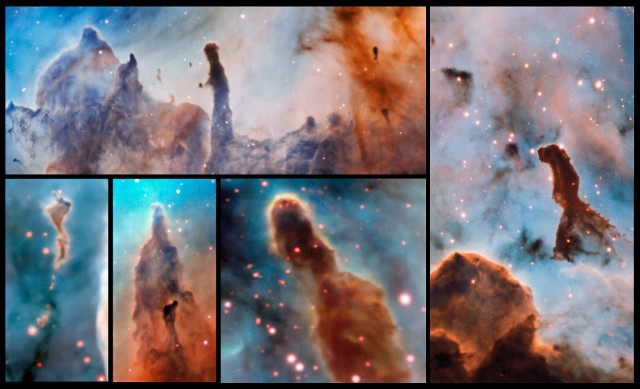
Pillars within the Carina Nebula (Image ESO/A. McLeod)

An article accepted for publication in the journal “Monthly Notices of the Royal Astronomical Society” describes a research on the large columnar structures in the Carina Nebula. A team led by Anna McLeod, a PhD student at ESO, used the MUSE instrument installed on ESO’s VLT (Very Large Telescope) to examine these structures that have been nicknamed “pillars of destruction” for certain similarities with the “Pillars of Creation” photographed by the Hubble space telescope.

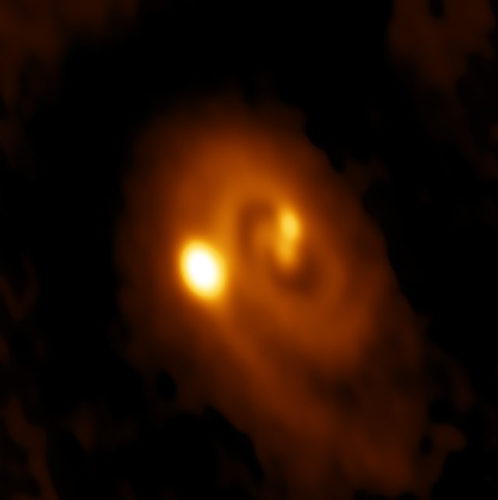
The L1448 IRS3B system (Image Bill Saxton, ALMA (ESO/NAOJ/NRAO), NRAO/AUI/NSF)

An article published in the journal “Nature” describes the discovery of a triple system in formation. An international team of scientists used the Atacama Large Millimeter / submillimeter Array (ALMA) and Karl G. Jansky Very Large Array (VLA) radio telescopes to observe the system called L1448 IRS3B, where a disk of dust and gas is fragmenting into a multiple star system.

The central part of the Milky Way (Image ESO/VVV Survey/D. Minniti)

An article published in “The Astrophysical Journal Letters” describes the discovery of the relics of an ancient globular cluster in the Milky Way’s central area. A team of astronomers led by Dante Minniti (Universidad AndrĂ©s Bello, Santiago, Chile) and Rodrigo Contreras Ramos (Instituto Milenio de AstrofĂ­sica, Santiago, Chile) used observations from the “Variables in the Via Lactea with VISTA” (VVV) survey carried out with ESO’s VISTA telescope to discover the ancient stars of type RR Lyrae for the first time in that area.

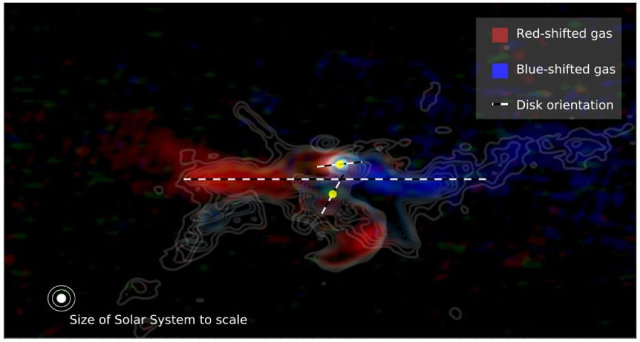
The IRS 43 system (Image courtesy Christian Brinch/NBI/KU)

An article published in “Astrophysical Journal Letters” describes a research on the IRS 43 system, which turned out to be really extraordinary because it’s formed by two very young stars each surrounded by a disk of gas but they share a third much bigger disk. A team of scientists from the Niels Bohr Institute, University of Copenhagen, used the ALMA radio telescope to discover this structure never seen before.

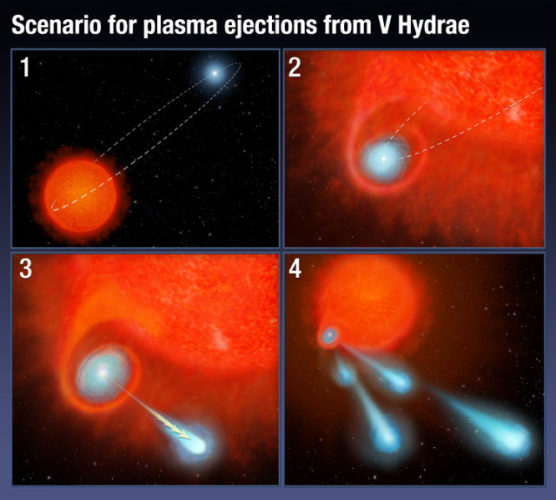
Sequence of interactions between V Hydrae and its companion that cause the ejection of plasma blobs (Image NASA, ESA, and A. Feild (STScI))

An article published in “The Astrophysical Journal” describes a research on the huge plasma blobs ejected by the red giant star V Hydrae. A team of astronomers led by Raghvendra Sahai of NASA’s JPL used the Hubble Space Telescope to study this phenomenon and concluded that the plasma blobs come from another star, a companion of V Hydrae that we can’t see.