
Stars

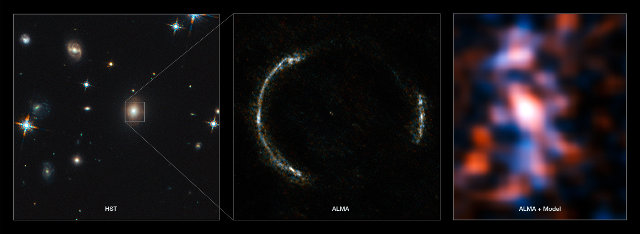
Pictures of the galaxy SDP.81. On the left a picture taken by the Hubble Space Telescope. In the middle, the galaxy as an Einsetin ring and on the left as it's seen after being processed to eliminate the gravitational lensing distorsion (Image ALMA (NRAO/ESO/NAOJ)/Y. Tamura (The University of Tokyo)/Mark Swinbank (Durham University))

ESO’s telescope ALMA (Atacama Large Millimeter / submillimeter Array) in Chile allowed to take the most detailed images ever obtained of a galaxy called HATLAS J090311.6+003906 or SDP.81. It’s about 11.4 billion light years from Earth and its light is distorted by the phenomenon called gravitational lensing. A galaxy between it and the Earth distorts its light with its huge gravity and the result is that we see an almost perfect ring, called an Einstein ring.

Image of the Medusa Nebula captures using the VLT telescope (Image ESO)

The most detailed image ever obtained of the Medusa Nebula was taken using ESO’s VLT (Very Large Telescope) in Chile. It reveals in a much better way the filaments of glowing gas that make it up. Those are snake-like filaments that led to the nickname Medusa with which is commonly known, inspired by the myth of the creature with snakes in place of hair. This nebula shows what might happen to the Sun some billion years in the future.

Image of the HL Tauri system taken by the ALMA telescope (Image ALMA (ESO/NAOJ/NRAO))

Last October a picture of the system HL Tauri captured by ESO’s ALMA (Atacama Large Millimeter / submillimeter Array) telescope was published. It showed a disk of dust that is slowly coalescing and was one of the sharpest images ever made at sumbillimetric wavelengths. According to many scientists there are planets that are forming in the system but others were skeptical and that created a debate. Now a team of astrophysicists from the University of Toronto led by Daniel Tamayo brought new evidence that there really are planets forming, published in the journal “Astrophysical Journal”.

Images of the April 28-29, 2015 solar filament captured by the SOHO space probe's coronographs (Image ESA/NASA/SOHO)

Between April 28 and 29, 2015 a solar flare produced a filament that spread to a really huge distance. The result is that the images of the space probe SOHO (Solar and Heliospheric Observatory) that captured the filament, to include it cover a wide area of ​​45 million kilometers (about 30 million miles).