Stars

The Alpha Centauri system as seen by the James Webb Space Telescope on the left, a zoom of the two main stars in the center, and a further zoom on the right indicating the exoplanet candidate designated as S1.

Two articles accepted for publication in “The Astrophysical Journal Letters” report different aspects of the study that led to the possible discovery of a gas giant planet orbiting the star Alpha Centauri A. Astronomers used observations with the James Webb Space Telescope’s MIRI instrument to identify a light source whose characteristics make it a candidate exoplanet. The information gathered suggests it may be a gas planet similar in size to Jupiter, although its mass could be close to Saturn’s. If confirmed, it would be the closest exoplanet orbiting a Sun-like star in its system’s habitable zone.

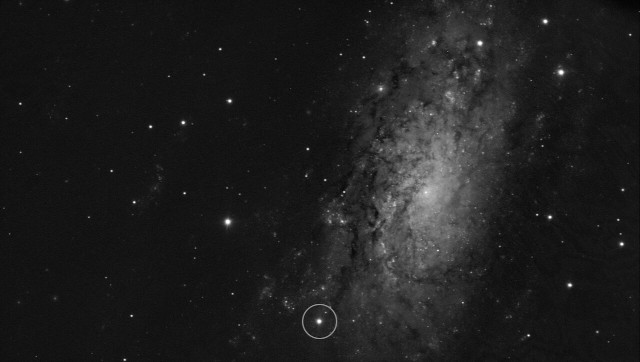
The fading light of supernova SN 2025kg, followed by the fast X-ray transient EP 250108a, as seen by the Gemini North and South telescopes

Two articles accepted for publication in “The Astrophysical Journal Letters” report different aspects of the study of supernova SN 2025kg, which generated a so-called fast X-ray transient, a little-known event that in this case was cataloged as EP 250108a. This type of event has now been described as a sort of stifled-at-birth version of a gamma-ray burst.

Two teams of researchers with several members in common used data collected by two instruments on the Einstein Probe space telescope and other instruments to analyze the emissions from this supernova. This allowed them to propose an explanation for the fast X-ray transients (FXTs) and how they differ from gamma-ray bursts.

The Sun observed across eight different wavelengths by the Solar Orbiter space probe

ESA has released the first information, including the first images, of the Sun’s South Pole, captured between March 16 and 17, 2025, by the Solar Orbiter space probe, a mission operated in collaboration with NASA. Three of the scientific instruments on board made it possible to observe that area in different electromagnetic bands: Polarimetric and Helioseismic Imager (PHI), Extreme Ultraviolet Imager (EUI), and Spectral Imaging of the Coronal Environment (SPICE). The Sun’s poles aren’t visible from Earth, and Solar Orbiter is observing them as never before. The first observations have already revealed some surprises.

ASKAP J1832-0911 (in the circle) (Image X-ray: NASA/CXC/ICRAR, Curtin Univ., Z. Wang et al.; Infrared: NASA/JPL/CalTech/IPAC; Radio: SARAO/MeerKAT; Image processing: NASA/CXC/SAO/N. Wolk)

An article published in the journal “Nature” reports a study on ASKAP J1832-0911, or simply ASKAP J1832, an object whose nature is still uncertain. A team of researchers combined data collected by different instruments, including NASA’s Chandra X-ray Observatory and the ASKAP radio telescope, to detect the emissions coming from this object. This allowed them to reveal anomalies with respect to the categories considered to try to identify it.

The radio emissions led to cataloging it as a long-period radio transient, but ASKAP J1832 has variable emissions of the same duration in X-rays as well. An object with that type of emissions has never been found before, so it arouses a lot of curiosity. It could be a magnetar or a white dwarf with a companion star, but its behavior remains strange, so the investigations will continue.

The Magellanic Clouds as seen by the Gaia space probe (Image ESA)

An article published in “The Astrophysical Journal Letters” reports the results of a study of the Small Magellanic Cloud that shows how this dwarf galaxy is undergoing distortions in its shape due to various gravitational influences. Satoya Nakano and Kengo Tachihara of Nagoya University, Japan, used data collected by ESA’s Gaia space probe together with information on Cepheid stars collected by the OGLE (Optical Gravitational Lensing Experiment) project. This allowed them to determine the distances of 4,236 Cepheids and the anomalies in their motions. The conclusion is that the Small Magellanic Cloud is undergoing a gravitational influence from the Large Magellanic Cloud and another as yet unknown source.