Stars

Artist's concept of black dwarf star (Image Baperookamo)

An article published in the journal “Monthly Notices of the Royal Astronomical Society” reports a research on the possibility that in a very distant future, estimated in 10^1100 years, even black dwarfs might explode in supernovae. Matt Caplan of the University of Illinois studied the models of white dwarf evolution as they will keep on cooling while pycnonuclear reactions, which occur at low temperatures but very high density, will generate iron-56. In quite a long time, even elementary particles will start decaying, and this will cause the explosion of the most massive black dwarfs, with masses between 1.2 and 1.4 times the Sun’s. It could be the last significant natural event in the universe.

Betelgeuse seen by Hubble (Image Andrea Dupree (Harvard-Smithsonian CfA), Ronald Gilliland (STScI), NASA and ESA)

An article published in “The Astrophysical Journal” reports a study on the star Betelgeuse’s dimming that occurred between the end of 2019 and the first quarter of 2020 that had suggested that its supernova explosion was imminent. A team of researchers led by Andrea Dupree of the Center for Astrophysics at Harvard and Smithsonian used the Hubble Space Telescope with ultraviolet observations to find traces of a gigantic mass of hot plasma that rose from Betelgeuse’s surface. That plasma moved away, cooling and turning into dust that covered the star’s surface, reducing its brightness to a third of normal.

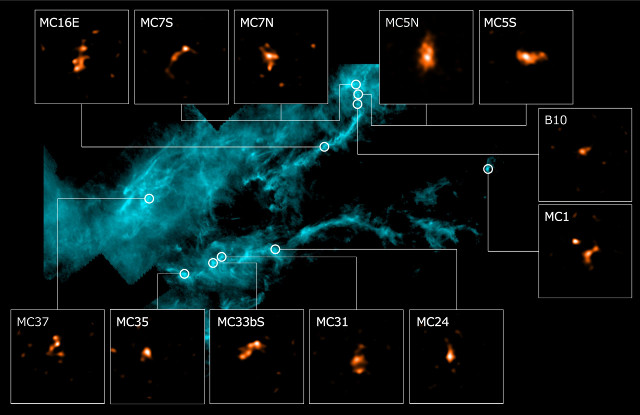
The stellar eggs seen by ALMA

Two articles, one published in “The Astrophysical Journal” and one in “The Astrophysical Journal Letters”, report a census of what were called stellar embryos in the Taurus Molecular Cloud. A team of researchers used the ALMA radio telescope to observe 32 prestellar objects and 7 protostars that offer new insights into the processes leading to the birth of stars. One of the articles focuses on the discovery of a bipolar outflow formed by a pair of gas streams that could be clues to the birth of a star.

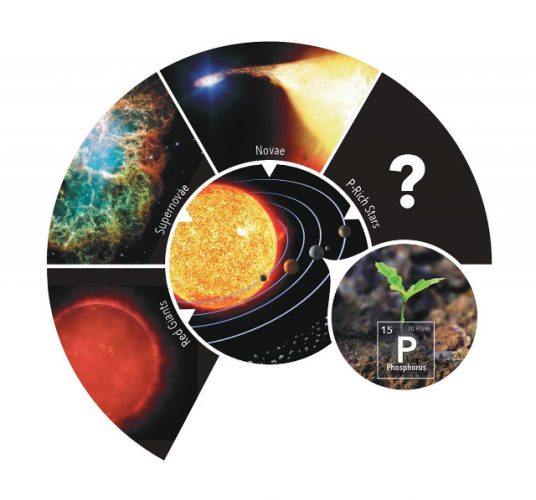
The possible origin of phosphorus

An article published in the journal “Nature Communications” reports the discovery of 15 stars that contain an unusual amount of phosphorus but also of other elements such as magnesium, silicon, oxygen, aluminum, and cerium, an anomaly that suggests a new type of object. A team of researchers led by Thomas Masseron of the Instituto de Astrofísica de Canarias (IAC) examined a large number of infrared spectra obtained during the Sloan Digital Sky Survey together with the optical spectrum of the brightest of the phosphorus stars obtained using the Echelle spectrograph installed at the Nordic Optical Telescope. The possible explanations will have to be tested, but this discovery explains the abundance in the Milky Way of phosphorus, an indispensable element for Earth’s life forms.

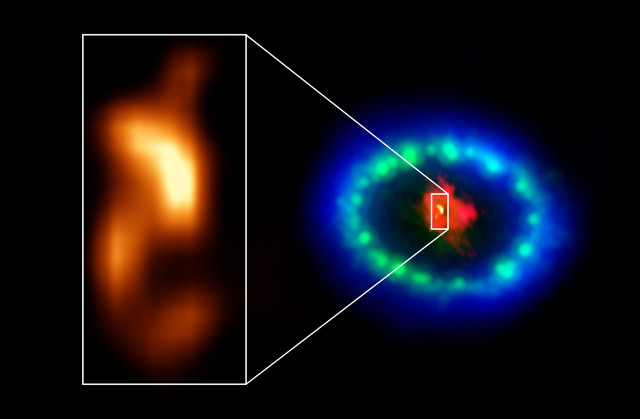
Extremely high-resolution ALMA images revealed a hot “blob” in the dusty core of Supernova 1987A (inset), which could be the location of the missing neutron star

Two articles published in “The Astrophysical Journal” reports two studies on the supernova SN 1987A remnants. Two teams of researchers led by Phil Cigan of the British University of Cardiff and Dany Page of the National Autonomous University of Mexico respectively used observations conducted with the ALMA radio telescope and follow-up theoretical studies to bring evidence that a neutron star formed after the supernova. If these results are confirmed, it would be the youngest known neutron star.