Stars

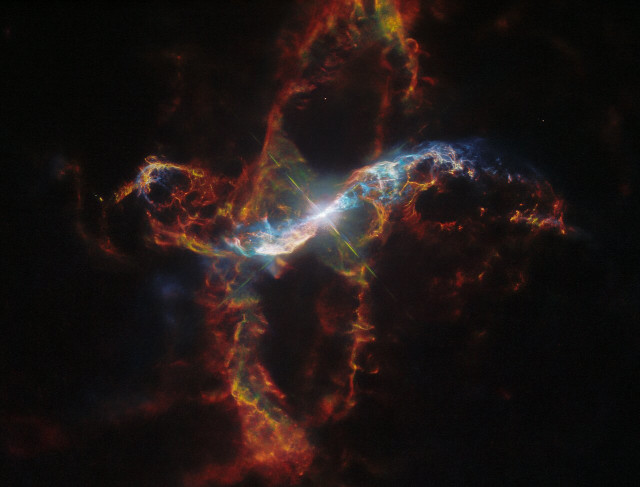
R Aquarii (NASA, ESA, M. Stute, M. Karovska, D. de Martin & M. Zamani (ESA/Hubble))

An image captured by the Hubble Space Telescope depicts R Aquarii, a binary system consisting of a red giant and a white dwarf. Four different filters of the WFC3 (Wide Field Camera 3) instrument were used in visible light to create the most recent observation of R Aquarii conducted with Hubble. This allowed to examine the changes that have occurred in particular in the nebula surrounding the pair.

The R Aquarii system is in the cosmic neighborhood, being about 650 light-years from Earth. For this reason, it has been the subject of study with different instruments since the two stars that make up the pair, which are invisible to the naked eye, were discovered. For example, it was the subject of a test using a subsystem of the SPHERE instrument installed on ESO’s VLT in Chile.

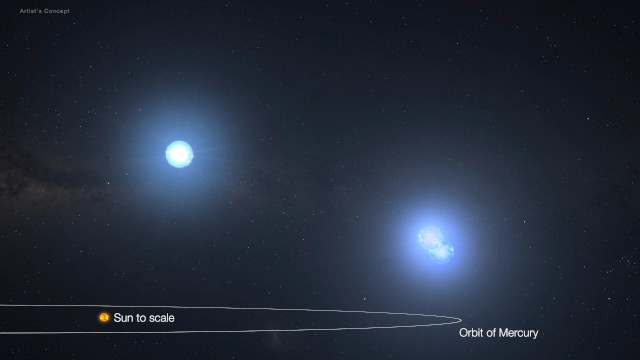
An illustration of the TIC 290061484 system with its three stars showing its compactness with a scale representation of the orbit of the planet Mercury in the solar system.

An article published in “The Astrophysical Journal” reports the discovery of the triple system cataloged as TIC 290061484, the most compact of its kind found so far. A team of researchers coordinated by NASA’s Goddard Space Flight Center used observations with NASA’s TESS space telescope, applied a machine learning technique, and involved citizen scientists who participated in the Planet Hunters project in a new project called the Visual Survey Group. This rare triple system will help astronomers better understand the processes of formation and evolution of multiple systems.

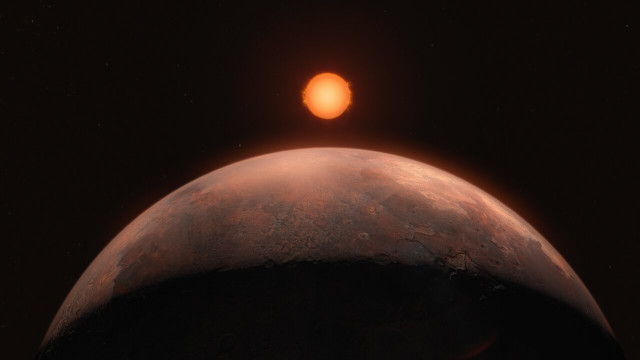
Artist’s impression of the exoplanet Barnard b with Barnard's Star in the background (Image ESO/M. Kornmesser)

An article published in the journal “Astronomy & Astrophysics” reports the identification of an exoplanet smaller than Earth orbiting Barnard’s Star. A team of researchers identified the exoplanet designated as Barnard b using the ESPRESSO instrument installed on ESO’s VLT in Chile. This discovery was later confirmed with other specialized exoplanet-hunting instruments: HARPS, HARPS-N, and CARMENES. The researchers also detected other signatures that suggest the presence of three exoplanet candidates, but follow-up investigations are needed to verify their existence.

The area of ​​the sky where the galaxy GS-NDG-9422, or simply 9422, was spotted, magnified in the inset in a view captured by the James Webb Space Telescope's Near Infrared Camera (NIRCam).

An article published in the journal “Monthly Notices of the Royal Astronomical Society” reports the discovery of a primordial galaxy that was cataloged as GS-NDG-9422, or simply 9422, in which nebular gas outshines stars. A team of researchers used observations conducted with the James Webb Space Telescope to study 9422 using in particular the NIRSpec (Near-Infrared Spectrograph) instrument to analyze its chemical composition. The conclusion is that this galaxy is in a phase never seen before in its evolution in which very massive and very hot stars make the nebular gas very hot and consequently bright.

The eROSITA bubbles seen in X-rays (green) and the magnetic field in the halo (white). The red color shows the polarized intensity of synchrotron radiation. The light blue circles represent the Fermi bubbles seen in gamma rays.

An article published in the journal “Nature Astronomy” reports a study of the so-called eROSITA bubbles that reveals magnetized structures that form a galactic halo aligned with them reaching heights of more than 16,000 light-years above the galactic plane. A team of researchers led by the Italian National Institute for Astrophysics conducted an investigation that spans the entire electromagnetic spectrum from radio waves to gamma rays to examine the eROSITA bubbles and map them. The alignment of the magnetized halo with the bubbles suggests a common origin, which could be given by star formation activity.