ULA

The Solar Orbiter space probe blasting off atop an Atlas V rocket (Photo ESA - S. Corvaja)

A few hours ago the Solar Orbiter space probe blasted off atop an Atlas V rocket from Cape Canaveral. After about 53 minutes, it successfully separated from the rocket’s last stage and began the long journey that will take it up to about 42 million kilometers from the Sun. A little later it deployed its solar panels and started communicating with the mission control center.

Boeing's CST-100 Starliner spacecraft blasting off atop an Atlas V rocket (Image NASA TV)

A little while ago, Boeing’s CST-100 Starliner spacecraft blasted off atop a ULA Atlas V rocket from the Cape Canaveral base in its Boe-OFT (Boeing Orbital Flight Test) mission. After about 15 minutes it successfully separated from the rocket’s last stage. After a little more than half an hour the first of a series of maneuvers for orbit insertion was schduled but a problem emerged that required that the possible options to be assessed to have the CST-100 Starliner go for a proper orbit insertion and on its way to carry out its mission. Boeing has control of the spacecraft, which is in a stable orbit, so it’s not in danger.

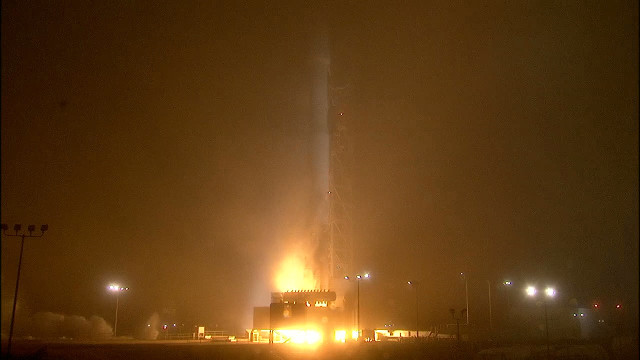
The InSight lander and the MarCO nanosatellites blasting off atop an Atlas V 401 rocket (Image NASA TV)

A few hours ago NASA’s InSight lander was launched together with the two Mars Cube One nanosatellites from the Vandenberg base on an Atlas V 401 rocket. After about 1.5 hours they separated from the rocket’s last stage, called Centaur, and went en route to Mars.

The InSight (Interior Exploration using Seismic Investigations, Geodesy and Heat Transport) mission aims to investigate the geology of the planet Mars. A lander equipped with a seismometer, a thermal sensor and other instruments that will analyze the red planet’s internal structure. This will allow to obtain new data on its formation, also contributing to the existing models on the formation of rocky planets such as the Earth.