
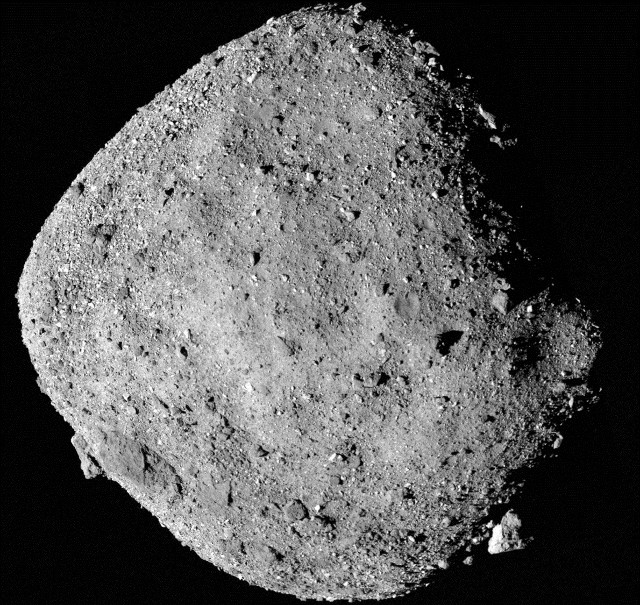
NASA has announced that its OSIRIS-REx space probe has found traces of water in the asteroid Bennu, reached on December 3. This is water bound to minerals present on Bennu’s surface, hydrated silicates formed in the very early stages of the solar system’s history, when the first small bodies such as the asteroids started forming.
In these days the OSIRIS-REx space probe is making a preliminary survey, arriving approximately 7 kilometers away from the asteroid Bennu to make the first measurements. The actual orbit entry is scheduled for the end of 2018 but to perform the maneuvers it needs to know Bennu’s gravitational attraction, because it influences OSIRIS-REx’s motion even if it’s minimal. This means also measuring Bennu’s mass and from the information gathered it will be possible to deduce its structure and composition.
In the course of its approach to the asteroid Bennu, the OSIRIS-REx space probe already started conducting its first measurements and the OSIRIS-REx Visible and Infrared Spectrometer (OVIRS) and OSIRIS-REx Thermal Emission Spectrometer (OTES) instruments detected the presence of molecules containing atoms of oxygen and hydrogen bound together, called hydroxyls. The team of mission scientists suspect that these hydroxyl groups are present throughout the asteroid in clay minerals, which means that in the remote past Bennu’s rock materials interacted with water. According to the scientists, Bennu is a fragment of a larger asteroid that also contained liquid water, which instead can’t exist in that state on a body as small as Bennu.
Amy Simon, scientist of the OVIRS instrument at NASA’s Goddard Space Flight Center, stated that the presence of hydrated minerals confirms that Bennu is an excellent asteroid for the OSIRIS-REx mission to study the composition of primordial volatile and organic materials. When samples of these materials are returned to Earth in 2023, scientists will receive a lot of new information about the solar system’s history and evolution.
The study of the early phases of the history of the solar system is one of the aims of the OSIRIS-REx mission thanks to the fact that the asteroid Bennu is a kind of fossil of that remote age. The samples that will be taken probably remained unchanged or almost unchanged for a few billion years and the extremely deep analyzes they’ll be submitted to after being brought back to Earth could offer new information on that remote era.
Another surprise arrived from the preliminary survey of the asteroid Bennu is the presence of a greater amount of rocks than expected by the models created thanks to observations made remotely over the past years. Near the south pole there’s a boulder whose height was estimated at around 50 meters for a length of about 55 meters. The model predicted a much smaller boulder, with a height of less than 10 meters.
The asteroid Bennu immediately showed interesting features and this is only the beginning of its exploration. The most ambitious part of the mission is the taking of the samples to be brought back to Earth, but the in-depth study by the OSIRIS-REx space probe is equally important, also for possible future mining operations on asteroids.
