July 2019

Photo of asteroid Ryugu's soil taken by the ONC-W1 camera (Photo courtesy JAXA. All rights reserved)

A few hours ago the Japanese space probe Hayabusa 2 touched down on the soil of asteroid Ryugu to collect some subsurface samples that will be transported to Earth. This is the second attempt of the three possible at the start of the mission. After the first sample taken on February 22, 2019, the Japanese space agency JAXA decided to proceed with a second attempt in another area to then finish Ryugu’s study and return to Earth with the samples taken.

Using neutron star mergers to estimate the speed of the universe expansion

An article published in the journal “Nature Astronomy” reports the use of observations of the neutron stars merger recorded on August 17, 2017 to try to calculate the value of the Hubble constant, which measures the speed of the universe expansion. That event is the most famous of those recorded so far for gravitational waves due to the importance it had for the so-called multimessenger astronomy but it has already proved useful also to offer an additional way to measure the expansion of the universe that is alternative to the two that are providing a discrepancy in their results.

Dust storms observed near Mars' northern polar cap

ESA has published images of dust storms sighted at the edge of the northern polar cap of the planet Mars between May 22 and June 10, 2019. The Mars Express space probe’s High Resolution Stereo Camera (HRSC) and Visual Monitoring Camera (VMC) instruments allowed to observe at least eight different storms that formed and dissipated very quickly for a duration between one and three days each during which they moved to the equator and the ancient volcanoes Olympus Mons and Elysium Mons. Those are short-lived local phenomena, small compared to the global storm that covered the entire planet last year, but help to understand the processes taking place in the Martian atmosphere.

Ancient quasars spin at relativistic speeds

An article published in “The Astrophysical Journal” reports an observation of 5 quasars between 9.8 and 10.9 billion light years away from Earth with the help of gravitational lenses that offered multiple images of them. A team of astronomers used NASA’s Chandra X-ray Observatory to study the accretion disks around the supermassive black holes that power those quasars, discovering that one of them spins at a speed higher than 70% of the speed of light.

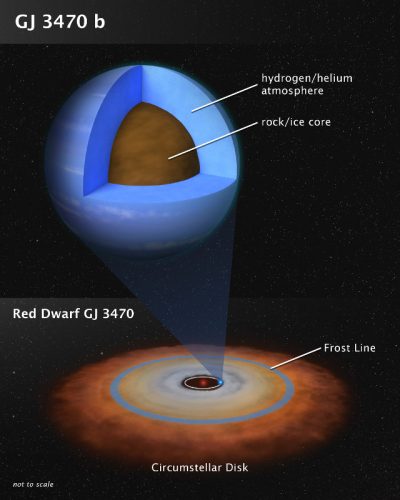
A study of the atmosphere of the exoplanet Gliese 3470 b

NASA used the Hubble e Spitzer space telescopes to study the composition of the atmosphere of Gliese 3470 b, a mini-Neptune that orbits very close to its star, which is a red dwarf but still heats it up to temperatures that are estimated on the surface between 700 and 900 Kelvin. Gaseous planets have an atmosphere composed mainly of hydrogen and helium but normally there are also other heavier elements, with the consequence that various molecules can form, but in Gliese 3470 b those elements are really scarce.