
An article published in “The Astrophysical Journal” reports a study on some ultraluminous X-ray sources observed in the galaxy NGC 6946. A team of researchers led by Hannah Earnshaw, a postdoctoral researcher at Caltech, used observations carried out with NASA’s NuSTAR space telescope of. In particular, their interest focused on one of the sources, cataloged as ULX-4, also observed with ESA’s XMM-Newton space telescope but after ten days NASA’s Chandra X-ray Observatory found no more traces of it. Such an event usually has a long duration so it could have been generated by a black hole or a neutron star on nearby debris.
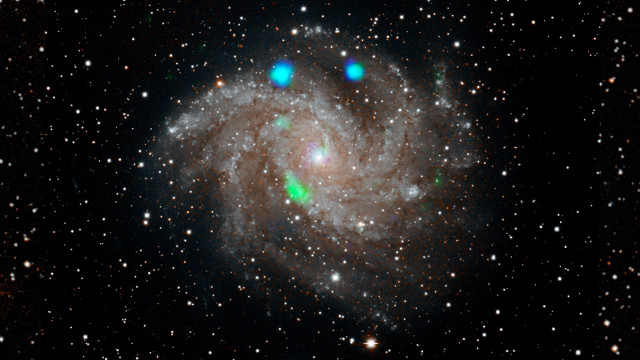
The galaxy NGC 6946 is of the spiral type, like the Milky Way, and is well known among astronomers because it’s of the starburst type, which means that there’s a considerable star formation in it. That’s been going on for millions of years and one consequence is that we’re seeing various blue giant stars explode into supernovae. For this reason it’s been nicknamed the Fireworks Galaxy and is the subject of several observations. However, within it they also identified ultraluminous X-ray sources, indicated in blue and green in the image of NGC 6946, the subject of specific studies.
The NuSTAR (Nuclear Spectroscopic Telescope Array) space telescope, launched in June 2012, was designed specifically to observe phenomena such as ultraluminous X-ray sources (in English ultraluminous X-ray source, hence the acronym ULX). In the case of the source cataloged as ULX-4, indicated in green under the center of the galaxy NGC 6946, the observations were also performed with the XMM-Newton space telescope.
Normally, ultraluminous X-ray sources have a long duration with slow changes while ULX-4’s dynamics were completely different. On May 21, 2017 the first observation with NuSTAR found nothing, instead after 10 days ULX-4 was at its peak of emissions and after 10 more days the Chandra Observatory detected no more traces of it.
The ULX-4 event showed strong X-ray emissions but there were no visible light detections, which would have indicated that it was another supernova in the galaxy NGC 6946. For this reason, the researchers proposed a couple of possible explanations to that anomalous phenomenon linked to a black hole or to a neutron star.
In the past, tidal destruction events have been observed in which a black hole – generally a supermassive one – destroyed a star. In those cases the duration was long so ULX-4 could be such an event on a smaller scale, with a relatively small mass black hole that quickly swallowed a star or a planet. Black holes can also attract debris into a disk that surrounds them and the closest ones can heat up to the point of emitting X-rays for a time that depends on the amount of materials close to them.
Another possible explanation for ULX-4 is related to the characteristics of neutron stars. They too have such gravity that they can attract debris that moves quickly in a disk around them. They can also have magnetic fields of such power to create “columns” that channel materials to the surface in a process that generates powerful X-rays.
Hannah Earnshaw stated that this result is a step forward in understanding some of the rarest and most extreme cases of growth of materials towards black holes or neutron stars. Her team called the discovery of ULX-4 a case of serendipity since it was a transient event detected during the study of known ultraluminous X-ray sources.
It’s possible that the source of the ULX-4 event isn’t really over but there are still debris that will approach the black hole or will be channeled to the surface of the neutron star. In that case, follow-up observations and a little luck are needed to capture the event in the act. The galaxy NGC 6946 proved once again to be very interesting to study.
