November 2019

60 Starlink satellites blasting off atop a Falcon 9 rocket (Image courtesy SpaceX)

A little while ago 60 satellites of the Starlink constellation were launched on a Falcon 9 rocket from Cape Canaveral. After about an hour they were successfully deployed into their orbit at an altitude of about 280 kilometers all together and then started slowly disperse. This is SpaceX’s second mission to put the Starlink constellation into orbit to provide a global Internet connection coverage.

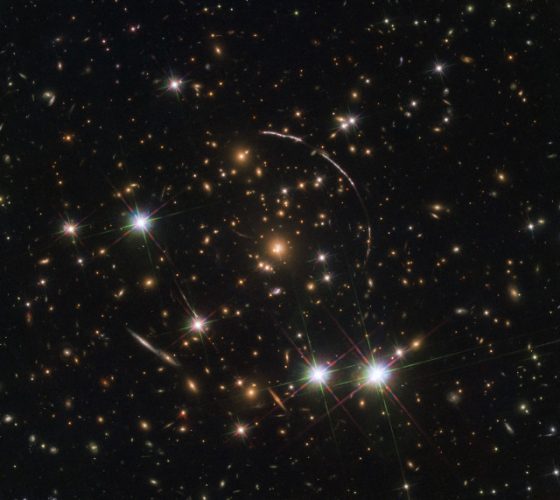
The image of an ancient galaxy multiplied by a gravitational lens

An article published in the journal “Science” reports a study of a galaxy nicknamed Sunburst Arc observed through a gravitational lensing effect that leads to multiplying its image obtaining at least 12 distorted copies in four large arcs. The Hubble Space Telescope detected the light from that galaxy, about 11 billion light years from Earth, thanks to that effect, which also made it between 10 and 30 times brighter. Studying such an ancient galaxy allows to gather information on the early universe and on what’s called the epoch of reionization.

A study of 20 radio galaxies offers new information on the activity of the supermassive black holes at their center

An article published in the journal “Astronomy & Astrophysics” reports a study on the properties of the ionized gas that surrounds supermassive black holes in 20 galaxies selected as a sample. A team of researchers led by Barbara Balmaverde of the Italian National Institute of Astrophysics, Turin, used the MUSE spectrograph mounted on ESO’s VLT in Chile to carry out the MURALES (MUse RAdio Loud Emission line Snapshot) survey, which includes the 20 galaxies studied. These are powerful sources of radio emissions thanks to their active galactic nuclei. The mapping of the ionized gas and its interaction with the relativistic jet produced by central black holes helps to understand the mechanisms of growth and interaction with their host galaxies.

Interstellar comet 2I/Borisov seen by Hubble (Image NASA, ESA, D. Jewitt (UCLA))

An article published in the “Astrophysical Journal Letters” reports the detection of what have been interpreted as traces of water emitted by interstellar comet 2I/Borisov. A team of researchers led by Adam McKay of NASA’s Goddard Space Flight Center used the Apache Point Observatory in New Mexico to study the light reflected from the comet detecting the “signature” of oxygen in large amounts. The most likely explanation for the presence of this element is that the ultraviolet light from the Sun broke the water molecules emitted into oxygen and hydrogen.

Artist's concept of a Voyager space probe (Image NASA/JPL-Caltech)

Five articles published in the journal “Nature Astronomy” report various detections carried out by NASA’s Voyager 2 space probe in interstellar space. A number of teams of researchers examined the data collected by the five instruments still in use with each article dedicated to the data from a single instrument. Taken together, they help to understand interstellar space outside the heliosphere, the bubble in which the influence of the Sun is felt. One year after coming out of that bubble, Voyager 2 sent a lot of data on plasma and cosmic rays showing the differences compared to those within the heliosphere.