2019

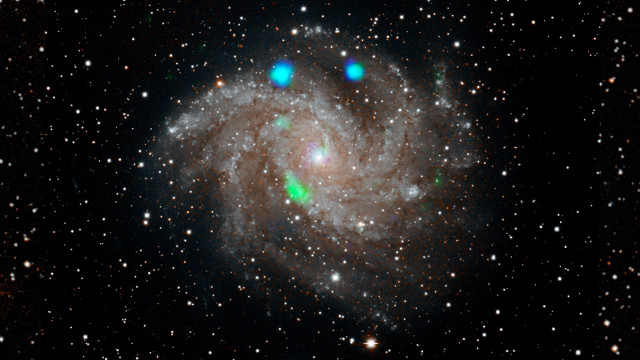
The galaxy NGC 6946 and its ULXs (Image NASA/JPL-Caltech)

An article published in “The Astrophysical Journal” reports a study on some ultraluminous X-ray sources observed in the galaxy NGC 6946. A team of researchers led by Hannah Earnshaw, a postdoctoral researcher at Caltech, used observations carried out with NASA’s NuSTAR space telescope of. In particular, their interest focused on one of the sources, cataloged as ULX-4, also observed with ESA’s XMM-Newton space telescope but after ten days NASA’s Chandra X-ray Observatory found no more traces of it. Such an event usually has a long duration so it could have been generated by a black hole or a neutron star on nearby debris.

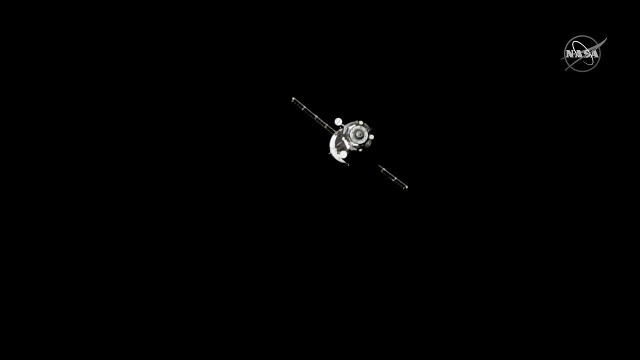
The Soyuz MS-14 spacecraft moving away from the International Space Station (Image NASA TV)

A few hours ago the Soyuz MS-14 spacecraft landed without problems in Kazakhstan. A few hours earlier it departed the International Space Station, where it arrived on August 27. The return to Earth ends a test mission that was carried out without cosmonauts aboard a spacecraft generally used for transporting human beings. In this case, the Skybot F-850 robot, nicknamed Fedor, was on board.

The landing on the Moon of the Indian Vikram lander and Pragyan rover didn’t succeed

The Indian Chandrayaan 2 mission’s Vikram lander and the Pragyan rover, launched on 22 July, attempted a Moon landing but something went wrong and the contact was lost at an altitude of about 2.1 kilometers. The Indian space agency ISRO’s engineers are analyzing the data collected, but probably there was some problem during the braking phase with loss of attitude and subsequent crash of the vehicles.

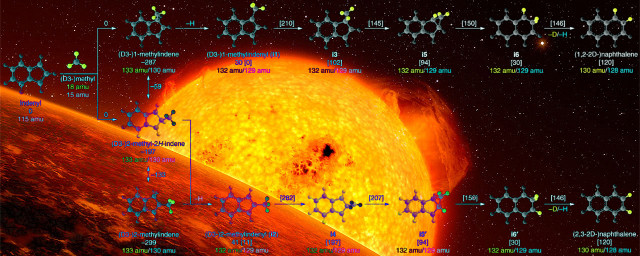
Life's building blocks can be formed from free radicals generated in space

An article published in the journal “Nature Communications” reports the discovery of a new method to form the organic compounds of the polycyclic aromatic hydrocarbon (PAH) group in space. A team of researchers at the Berkeley National Laboratory found what in jargon is called a pathway to get to the formation of PAHs such as naphthalene from simpler molecules. These compounds are important in the formation of amino acids, the building blocks of large biological molecules.

The star GJ 1061 (Image courtesy Centre de Données astronomiques de Strasbourg / SIMBAD / SDSS)

An article being published in the journal “Monthly Notices of the Royal Astronomical Society” reports the discovery of three super-Earths in the system of the red dwarf star GJ 1061. A team of astronomers from the Red Dots collaboration made this discovery during the 2018 observation campaign thanks to a series of spectroscopic detections obtained over three months using the radial velocity method. The masses of these exoplanets are a bit higher than the Earth’s and the outermost is in ​​its system’s habitable zone, where it receives an amount of energy from its star close to what the Earth receives from the Sun.