
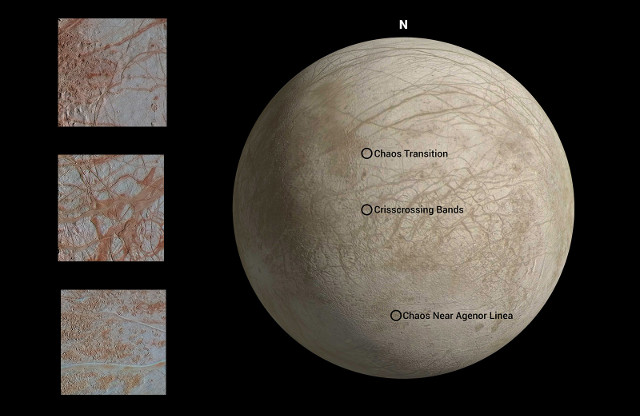
NASA has published reprocessed versions of three old photos of areas of the surface of Jupiter’s large moon Europa taken by the Galileo space probe on September 26, 1998. NASA scientists applied some processing techniques developed in recent years to the images obtaining new details of a series of geological features existing at the time on Europa’s frozen surface. This result offers is immediately useful for scientists interested in studying this moon and for the future because NASA is preparing the Europa Clipper mission, which also aims to try to understand what’s hidden in Europa’s underground ocean, with the hope to find life forms.
In the 1990s, Europa was already an important study target and on September 26, 1998, the Galileo space probe flew by this moon, one of the 11 total flybys accomplished during its mission. High resolution black and white photos revealed geological features with a resolution of approximately 460 meters. By combining those images with others in color but at a lower resolution taken during another flyby, it was possible to create a high-resolution color map of those areas.
At the time, the mapping process carried out by combining the different images was complex and time-consuming, but in the meantime image processing techniques have been developed that enable to obtain much better results with enhanced colors that bring out the various geological characteristics in different tones. Light blue or white areas are composed of relatively pure water while the reddish areas have more materials of other types such as salts.
The image (NASA/JPL-Caltech) shows a photo of Europa with the areas covered by the reprocessed photos in the circles and the new photos obtained after the reprocessing on the left side. These photos are being analyzed by scientists interested in Europa’s surface formation mechanisms.
The estimated age of the frozen crust is between 40 and 90 million years, which means it’s younger than the moon, one of the youngest surfaces in the solar system. The fractures open and close repeatedly due to the continuous action of the planet Jupiter’s gravity. The stripes are present in the areas where there are cracks that are constantly opened horizontally originating vast and flat structures. The areas defined as chaotic terrains contain blocks that moved sideways, rotating or tilting before freezing in their new positions.
Applying new processing techniques to old images is very useful, but to get some answers on what’s hidden in Europa’s underground ocean we will probably have to wait for NASA’s Europa Clipper mission. Initially, a lander was also planned, but precisely because the information on the surface is still limited, it was decided to launch only a space probe and then develop a separate mission after collecting enough data. Now the problem is that the Europa Clipper mission has been developed for some time being scheduled for a launch on NASA’s SLS, which is still under development. As a result, the space probe could be launched on another rocket. The study of Europa might begin only in the next decade, hoping to be able to understand if there are any life forms.
