May 2020

Artist's concept of the TRAPPIST-1 system (Image courtesy NAOJ)

An article published in “The Astrophysical Journal Letters” reports a study on the alignment of the ultra-cool dwarf star TRAPPIST-1 with its system’s 7 planets. A team of researchers led by Teruyuki Hirano of the Tokyo Institute of Technology used the Subaru telescope on Mount Mauna Kea, Hawaii, to observe that system not finding a significant misalignment of the planets with respect to their star. The astronomers who conducted the study warn that the measurements’ accuracy is not enough to completely rule out a small misalignment, but the result is significant in the study of the evolution of very small stars’ planetary systems.

Ascuris Planum seen by Mars Express

ESA has published photos of the plateau called Ascuris Planum on the planet Mars captured by the Mars Express space probe’s High Resolution Stereo Camera (HRSC). The landscape is full of fractures, deep scars generated by intense and prolonged tectonic forces that acted on the red planet for hundreds of millions of years. Those fractures are the extensions of the troughs existing in the area called Tempe Fossae, in the region called Tempe Terra, north-east of the vast region of Tharsis, where in ancient times active volcanoes generated enormous stress in the Martian crust and consequently the tectonic horst and graben visible today.

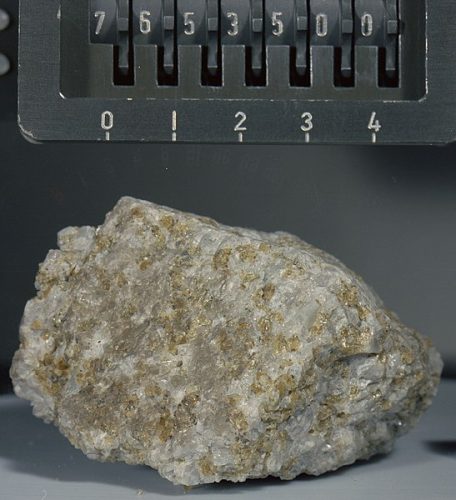
The sample Troctolite 76535

An article published in the journal “Nature Astronomy” reports evidence of significant impacts on the primordial Moon, at least 4.33 billion years ago. A team of researchers carried out a study in particular on the sample cataloged as Troctolite 76535, taken during the Apollo 17 mission in 1972 and brought back to Earth. This specimen contains traces of cubic zirconia, a crystalline form of zirconium oxide that forms above 2370° Celsius, a temperature that could only be reached following violent impacts that could have contributed to the formation of the Moon’s surface.

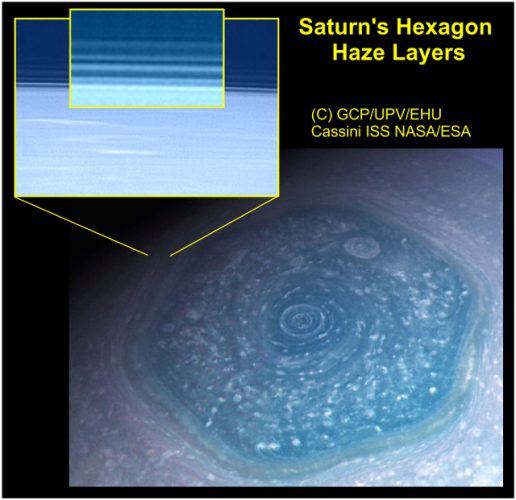
Saturn's hexagon and its layers

An article published in the journal “Nature Communications” reports a study on the stratification of the hexagonal structure of the gigantic hurricane that occupies the planet Saturn’s north pole. A team of researchers led by Professor Agustín Sánchez-Lavega of the University of the Basque Country used data collected by the Cassini space probe and the Hubble space telescope to understand that it’s a system composed of at least seven layers of haze with an extension of over 300 kilometers. The study also allowed to discover that those layers contain microscopic frozen particles composed of hydrocarbons such as acetylene, propane, propine, diacetylene, and butane.

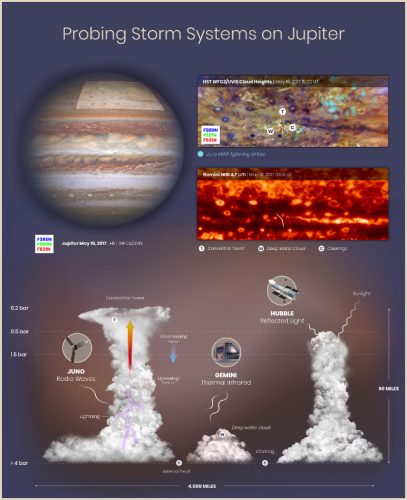
A graphic of the combined observations of Jupiter

An article published in “The Astrophysical Journal Supplement Series” reports the results of a series of combined observations of the planet Jupiter. A team of researchers led by Michael Wong of the University of California, Berkeley, used data collected by the Hubble Space Telescope, the Gemini Observatory in Hawaii and NASA’s Juno space probe to obtain a broader picture of various phenomena taking place in Jupiter’s atmosphere. Storms include the Great Red Spot, which the combined observations help us understand better.