May 2020

Geological feature in Hellas Planitia (Image NASA JPL-Caltech UoA Matt Balme & William McMahon)

An article published in the journal “Nature Communications” reports evidence of the existence of a river of a size comparable to that of the great European rivers such as Po and Rhine in the Izola mensa area, an outcrop within the large Hellas Planitia basin on the planet Mars. A team of researchers led by Dr. Francesco Salese and Dr. William McMahon examined high-resolution images captured by NASA’s Mars Reconnaissance Orbiter (MRO) space probe to identify traces of an area where some 3.7 billion years ago there was a large river. The environmental conditions had to be favorable to a constant flow of water for a long period with a hydrological cycle, yet another confirmation that at the time the red planet was similar to Earth.

Artist's concept of the HR 6819 system

An article published in the journal “Astronomy & Astrophysics” reports the discovery of a black hole in a triple system known as HR 6819. A team of researchers led by ESO’s Thomas Rivinius used the FEROS spectrograph on the MPG/ESO 2.2 meter telescope at La Silla to examine that system in a study on binary systems, surprisingly discovering the presence of a third object identified as a black hole. It’s the closest black hole to the solar system, but according to the researchers it could be the tip of the iceberg, and there could be many others like that, as predicted by theoretical models.

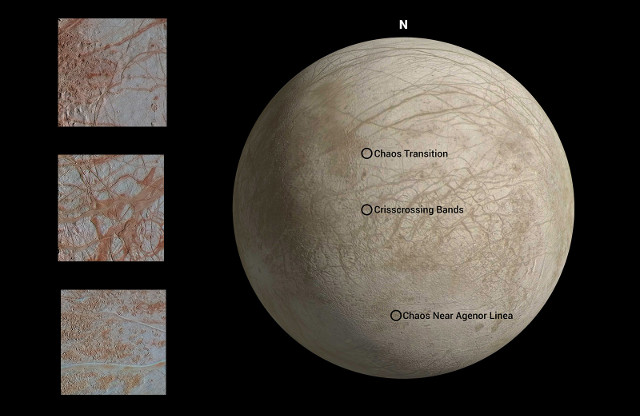
Europa seen by the Galileo space probe

NASA has published reprocessed versions of three old photos of areas of the surface of Jupiter’s large moon Europa taken by the Galileo space probe on September 26, 1998. NASA scientists applied some processing techniques developed in recent years to the images obtaining new details of a series of geological features existing at the time on Europa’s frozen surface. This result offers is immediately useful for scientists interested in studying this moon and for the future because NASA is preparing the Europa Clipper mission, which also aims to try to understand what’s hidden in Europa’s underground ocean, with the hope to find life forms.

The 15 protoplanetary disks photographed by the VLTI

An article published in the journal “Astronomy & Astrophysics” reports the first case of high-resolution infrared observations of the internal areas of 15 protoplanetary disks performed by combining the four telescopes of the ESO VLT interferometer in Chile. A team of researchers led by Jacques Kluska of the Katholieke Universiteit Leuven in Belgium used the PIONIER instrument to achieve this result, which also shows traces of planetary formation. This type of observation offers new information on this process.

The Moon landers by Dynetics, SpaceX and Blue Origin / National Team

NASA has announced the choice of three companies to design and develop human landing systems for the Artemis program. These are essentially plans for a lunar lander among which one will be selected to be built for the mission that, according to plans, is supposed to bring American astronauts back to the Moon by 2024. The companies selected are Blue Origin (actually the first contractor for a group called National Team), Dynetics, and SpaceX. This stage of development involves a 10-month base period during which companies and NASA will work together on the selected projects. The total contract value is $967 million.