June 2020

The sky seen at X-rays by eROSITA

The Max Planck Institute for Extraterrestrial Physics (MPE) has published an X-ray universe map obtained thanks to the eROSITA instrument, which the institute built for the Spektr-RG space telescope. This map includes about a million objects related to the hot and energetic part of the universe. It’s about 4 times deeper than the previous map of this type and contains about 10 times the number of energy sources, the equivalent of those discovered by all X-ray telescopes combined in over half a century of observations. It took about six months for eROSITA to complete this survey, which is only the first of eight expected in the course of about four years that will offer information that is likely to be used for decades.

NGC 6302 seen by Hubble (Image NASA, ESA, and J. Kastner (RIT))

An article in the journal “Galaxies” reports a study of the planetary nebulae NGC 6302, also known as the Butterfly Nebula for its shape, and NGC 7027. A team of researchers used the Hubble Space Telescope in multiple wavelength observations to offer the most complete views ever obtained of these two planetary nebulae. Both of them were already studied with Hubble and many other instruments in the past, but the Wide Field Camera 3 instrument allowed to obtain more details that mean more scientific information on the processes in progress and even more spectacular images.

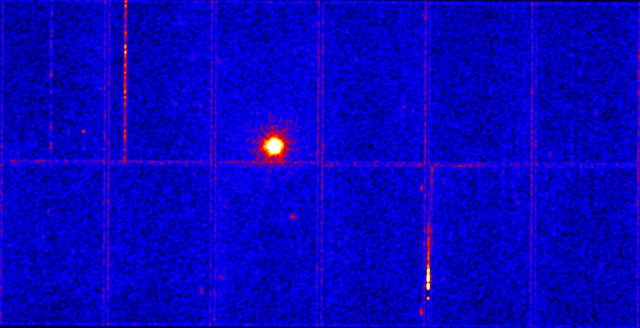
Swift J1818.0-1607 observed by XMM-Newton (Image courtesy ESA/XMM-Newton; P. Esposito et al. (2020))

An article published in “The Astrophysical Journal Letters” reports a study on Swift J1818.0-1607, the youngest pulsar discovered so far, which offers evidence that it’s at the same time a magnetar and one of the very few to also have radio emissions. A team of researchers have used ESA’s XMM-Newton, NASA’s Swift and NuSTAR space telescopes to detect X-ray emissions, and the Sardinia Radio Telescope to detect radio emissions in a complex observation campaign necessary to study the combined characteristics of the two types of neutron star.

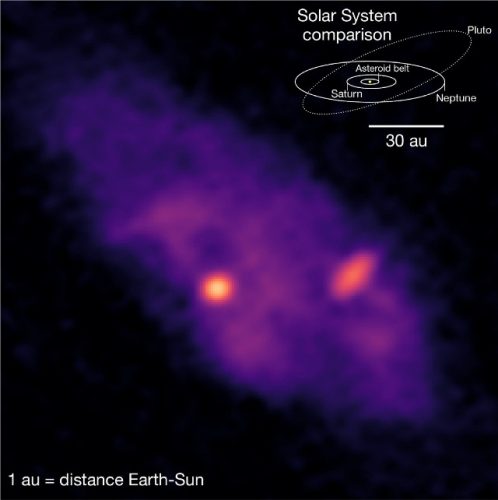
Illustration of GW Orionis's rings

An article published in “The Astrophysical Journal Letters” reports a study of the triple system of GW Orionis, or simply GW Ori, and in particular of the interactions between the three stars that compose it and the disk of gas and dust that surrounds it, divided in three rings. A team of researchers coordinated by the Department of Physics & Astronomy of the University of Victoria, Canada, used the ALMA radio telescope to conduct the observations necessary to identify the three rings, to estimate their masses, and to discover a misalignment between them.

The protostars in IRAS 16293-2422 A

An article accepted for publication in “The Astrophysical Journal” reports observations of a pair of protostars in a system in its formation phase cataloged as IRAS 16293-2422 A. A team of researchers from the astrochemistry group of the Max Planck Institute for Extraterrestrial Physics (MPE) in Munich, Germany, used the ALMA radio telescope to study the two protostars, cataloged as A1 and A2, since it can detect the emissions not filtered by the materials that surround them, also forming the circumstellar disks from to which planets may form in the future. The two protostars are in the initial phase of their formation and are still surrounded by the molecular cloud that constitutes the source of the gas and dust that are forming them.