July 2020

Tianwen-1 blasting off atop a Long March 5 rocket (Photo courtesy Xinhua/Cai Yang)

A few hours ago the Chinese mission Tianwen-1 blasted off atop a Long March 5 rocket from the Wenchang center in China. About 36 minutes after the launch, the spacecraft regularly separated from the rocket’s last stage and entered the trajectory that is scheduled to bring it into the planet Mars’ orbit in February 2021. There, a lander and a rover will separate from the space probe that will remain in orbit and will land on the red planet.

3D rendition of coronae on Venus (Image courtesy Laurent Montési / University of Maryland)

An article published in the journal “Nature Geoscience” reports the identification of 37 volcanoes that were active recently on the planet Venus. A team of researchers used models of thermo-mechanical activity under the surface of Venus to create 3D simulations of the formation of ring structures known as coronae that form when plumes of hot materials within the planet rise through the layers of the mantle and crust. This study offers what the authors claim is the best evidence ever found that Venus is still a geologically active planet.

The Hope space probe blasting off atop an H-IIA rocket (Image courtesy MHI / JAXA)

A few hours ago the Arab space probe Hope, or Al Amal, was launched atop an H-IIA rocket from the Tanegashima space center in Japan. About an hour after the launch, Hope regularly separated from the rocket’s last stage and went on the route that is scheduled to take it to the planet Mars’ orbit in February 2021. The communication of the solar panel deployment had a few minutes of delay, and that caused concern at the mission control center at the Mohammed bin Rashid Space Centre, but in the end, everything went well.

Chandra Deep Field-South with the 28 heavily obscured supermassive black holes

An article published in “The Astrophysical Journal” reports the discovery of 28 heavily obscured supermassive black holes. A team led by Erini Lambrides of Johns Hopkins University combined over 80 days of observations of NASA’s Chandra space telescope in the survey known as Chandra Deep Field-South (CDF-S) with the ones of other telescopes that include Hubble and Spitzer to identify active galactic nuclei whose emissions at many wavelengths were blocked by the huge cocoon of materials that surrounds them. The heavily obscured supermassive black holes are among the most sought after because understanding their growth mechanisms helps to understand the evolution of these extreme objects that can have masses even billions of times the Sun’s.

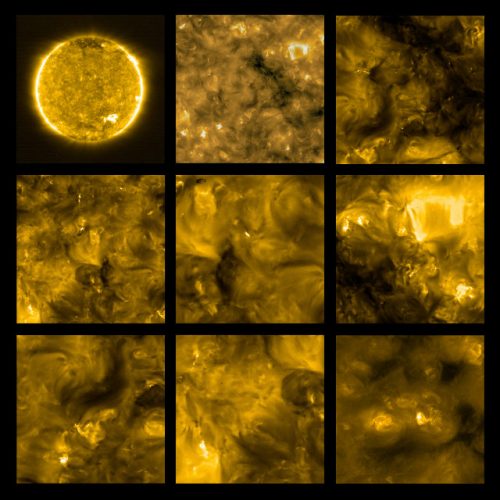
The Sun and its campfires seen by Solar Orbiter

ESA and NASA have published images captured by the Solar Orbiter space probe during its first Sun flyby. In this case, flying by means at a distance of about 77 million kilometers (48 million miles). During that maneuver, all its instruments were active after they were tested and commissioned despite the problems resulting from the Covid-19 pandemic with the difficulties for mission engineers and scientists. Among the first images, there are the ones of the so-called campfires, eruptions that are small by solar standards but are larger than many Earth nations.