2020

The HTV-9 spacecraft blasting off atop a H-IIB rocket (Image courtesy JAXA)

A little while ago the HTV-9 spacecraft blasted off atop a H-IIB rocket from the Tanegashima space center in Japan for a resupply mission to the International Space Station. About fifteen minutes after the launch, the cargo spacecraft separated regularly from the rocket’s last stage, entered its preliminary orbit and deployed its solar panels and navigation antennas.

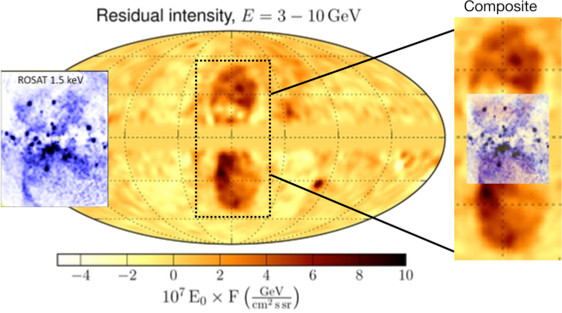
Gamma-ray and X-ray observations of the center of the Milky Way

An article published in “The Astrophysical Journal” offers an explanation of the origin of the so-called Fermi bubbles, the two gigantic gas bubbles existing above and below the center of the Milky Way. Guo Fulai and Zhang Ruiyu of the Shanghai Astronomical Observatory (SHAO) of the Chinese Academy of Sciences conducted a series of simulations that allowed to create a model that explains the origin of the Fermi bubbles and at the same time of the biconical X-ray structure at the center of the galaxy. According to the new model, the two phenomena are caused by shock waves generated by two jets from Sagittarius A*, or simply Sgr A*, the supermassive black hole at the center of the Milky Way, around 5 million years ago.

Artist's concept of the TRAPPIST-1 system (Image courtesy NAOJ)

An article published in “The Astrophysical Journal Letters” reports a study on the alignment of the ultra-cool dwarf star TRAPPIST-1 with its system’s 7 planets. A team of researchers led by Teruyuki Hirano of the Tokyo Institute of Technology used the Subaru telescope on Mount Mauna Kea, Hawaii, to observe that system not finding a significant misalignment of the planets with respect to their star. The astronomers who conducted the study warn that the measurements’ accuracy is not enough to completely rule out a small misalignment, but the result is significant in the study of the evolution of very small stars’ planetary systems.

Ascuris Planum seen by Mars Express

ESA has published photos of the plateau called Ascuris Planum on the planet Mars captured by the Mars Express space probe’s High Resolution Stereo Camera (HRSC). The landscape is full of fractures, deep scars generated by intense and prolonged tectonic forces that acted on the red planet for hundreds of millions of years. Those fractures are the extensions of the troughs existing in the area called Tempe Fossae, in the region called Tempe Terra, north-east of the vast region of Tharsis, where in ancient times active volcanoes generated enormous stress in the Martian crust and consequently the tectonic horst and graben visible today.

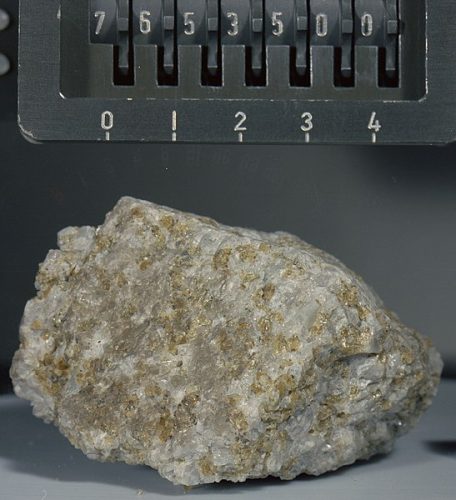
The sample Troctolite 76535

An article published in the journal “Nature Astronomy” reports evidence of significant impacts on the primordial Moon, at least 4.33 billion years ago. A team of researchers carried out a study in particular on the sample cataloged as Troctolite 76535, taken during the Apollo 17 mission in 1972 and brought back to Earth. This specimen contains traces of cubic zirconia, a crystalline form of zirconium oxide that forms above 2370° Celsius, a temperature that could only be reached following violent impacts that could have contributed to the formation of the Moon’s surface.