2020

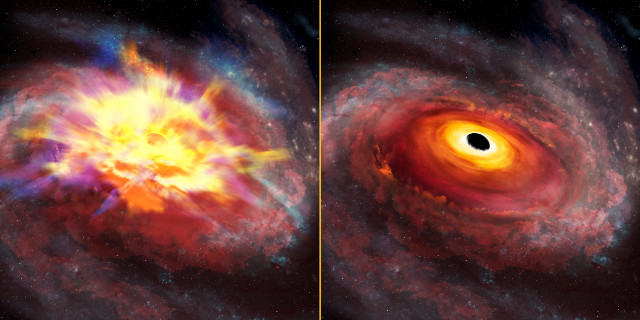
Artistic concept of the quasar SDSS J135246.37+423923.5 and the galaxy that hosts it

An article published in “The Astrophysical Journal” reports the discovery of the most energetic outflow from a distant quasar, to be precise from the one classified as SDSS J135246.37+423923.5. A team of researchers used the Gemini North telescope, Hawaii, to conduct the observations they needed and a new computer modeling system had to be used to interpret what was called an extragalactic storm hidden in plain sight for 15 years. The outflow, a sort of cosmic wind, travels at a speed that is almost 13% of the speed of light with a strong impact on the star formation in the galaxy hosting the quasar.

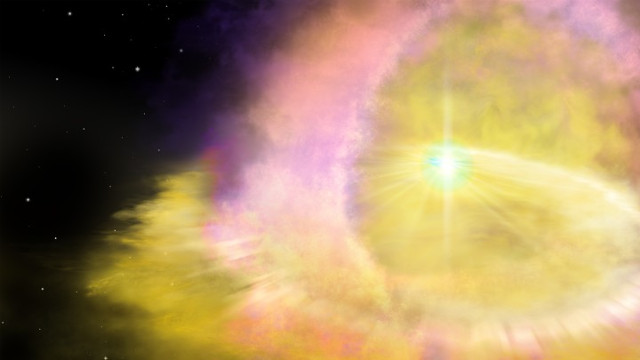
Artist's impression of a supernova (Image Aaron Geller (Northwestern University))

An article published in the journal “Nature Astronomy” reports a study on the supernova cataloged as SN2016aps, which was found to be at least twice as bright and probably much more massive than any other registered supernova. A team of astronomers led by Dr. Matt Nicholl of the British University of Birmingham observed the evolution of the supernova for about two years until it faded to 1% of its peak brightness. The conclusion is that the initial mass of the exploded star might have been even more than 100 times the Sun’s and this suggests that it was a very rare type called a pulsational pair-instability supernova.

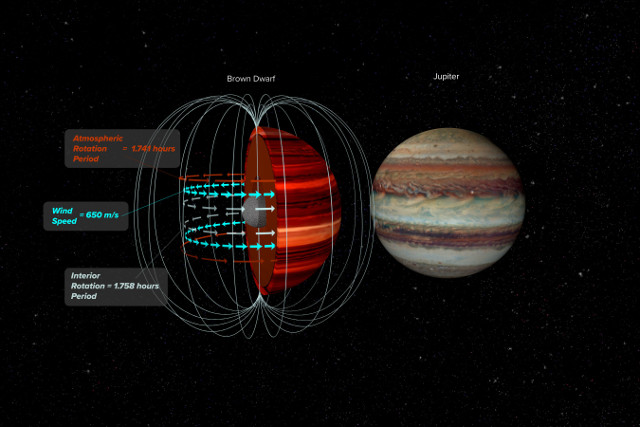
Illustration of brown dwarf and Jupiter

An article published in the journal “Science” reports the first measurement of the winds blowing in the atmosphere of the brown dwarf cataloged as 2MASS J10475385+2124234. A team of researchers led by Katelyn Allers of Bucknell University combined observations conducted with the Very Large Array (VLA) and NASA’s Spitzer space telescope to achieve this result. The method was already used for planets like Jupiter, so the news is its extension to a brown dwarf, and could also concern gaseous exoplanets.

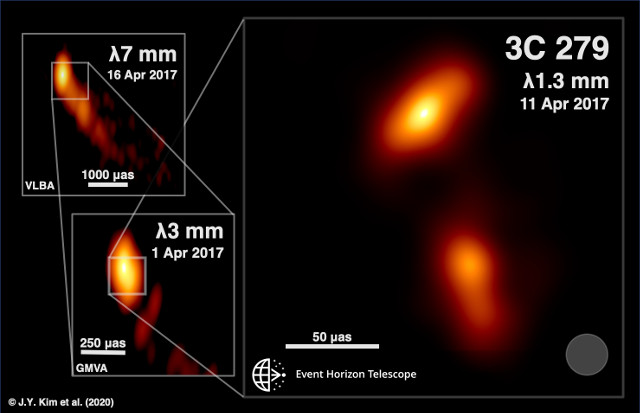
The blazar 3C 279

An article published in the journal “Astronomy & Astrophysics” reports the creation of images of the blazar 3C 279 by the Event Horizon Telescope (EHT) Collaboration. One year after the presentation of the photo of the area around the supermassive black hole at the center of the galaxy Virgo A, also known as M87, the international collaboration that used a series of radio telescopes to obtain the most detailed astronomical image of the history of an object millions of light years away offers the results of another observation campaign. Again, an object of that type was at the center of the attention, but 3C 279 is about a hundred times farther away than Virgo A. Despite this, EHT captured the sharpest details ever obtained of a relativistic jet produced by a supermassive black hole, of which it was also possible to trace the origin.

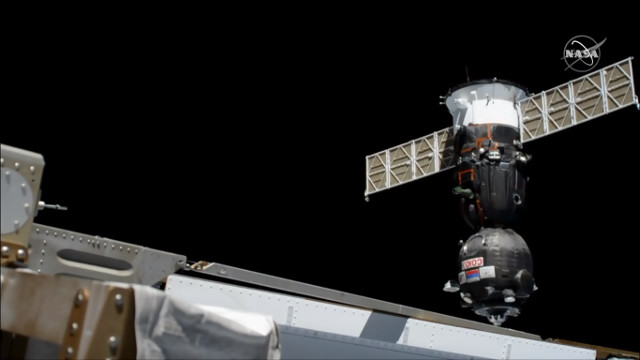
The Soyuz MS-16 spacecraft docking with the International Space Station (Image NASA TV)

A little while ago the Soyuz MS-16 spacecraft was launched from the Baikonur Cosmodrome in Kazakhstan and after a little more than six hours reached the International Space Station with three astronauts on board. In the period preceding a launch, it’s normal for astronauts and cosmonauts to remain in quarantine. In this case it was also extended to the personnel who managed the launch, with limits to the people who could have been in Baikonur.