
2020

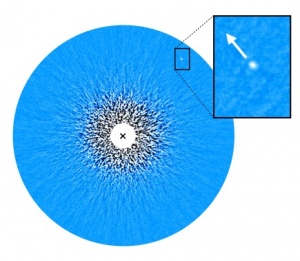
The brown dwarf GJ 504 B's system

An article published in “The Astronomical Journal” offers an explanation of the formation mechanisms of gas giant planets and brown dwarfs bringing evidence that these are two different mechanisms. A team of astronomers led by Brendan Bowler of the University of Texas, Austin, conducted observations at the Keck Observatory and with the Subaru Telescope, both in Hawaii, accompanied by computer simulations using the free / open source orbitize! software to try to understand if there were orbital differences that indicated a different origin between these objects. Their conclusion is that brown dwarfs have significantly more elliptical orbits.

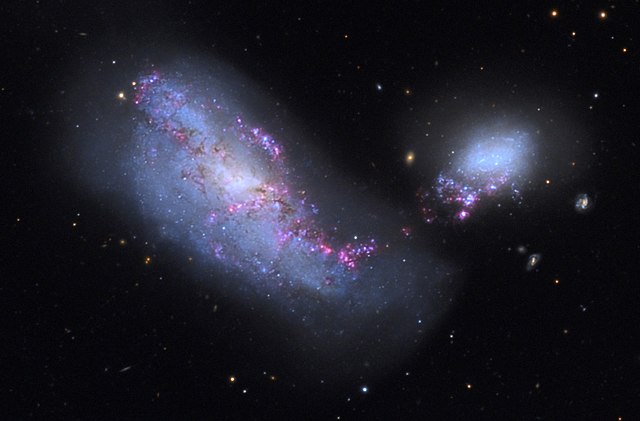
NGC 4490 and NGC 4485

An article accepted for publication in “The Astrophysical Journal” reports evidence that the galaxy NGC 4490 has a double nucleus. A team of researchers led by Allen Lawrence of Iowa State University studied data collected using various telescopes to find traces of two different nuclei in NGC 4490. One of the two nuclei can be seen at optical wavelengths, the other is hidden by dust and can be seen only at infrared and radio wavelengths, capable of passing through those dusts. Lawrence saw the double nucleus about seven years ago when he was an astronomy student even though at the time he was about 70 years old.

The Solar Orbiter space probe blasting off atop an Atlas V rocket (Photo ESA - S. Corvaja)

A few hours ago the Solar Orbiter space probe blasted off atop an Atlas V rocket from Cape Canaveral. After about 53 minutes, it successfully separated from the rocket’s last stage and began the long journey that will take it up to about 42 million kilometers from the Sun. A little later it deployed its solar panels and started communicating with the mission control center.

Pluto

An article published in the “Journal of Geophysical Research” reports a study on the dwarf planet Pluto and in particular on the heart-shaped region called Tombaugh Regio and its influence on global atmospheric circulation. A team of researchers coordinated by NASA’s Ames Research Center used data collected by the New Horizons space probe to specifically study nitrogen circulation and its cycle appropriately compared to a heart beat. This is another confirmation that Pluto is an active small world despite its small size and thin atmosphere.

Christina Koch, Alexander Skvortsov and Luca Parmitano assisted after their landing (Image NASA TV)

A little while ago astronauts Luca Parmitano and Christina Koch and cosmonaut Alexander Skvortsov returned to Earth on the Soyuz MS-13 spacecraft, that landed in Kazakhstan. Parmitano and Skvortsov spent a bit more than 6 months on the International Space Station, where they arrived on July 20, 2019 as part of Expedition 60, while Christina Koch arrived on March 15, 2019 as part of Expedition 59 and accomplished a long mission.