2020

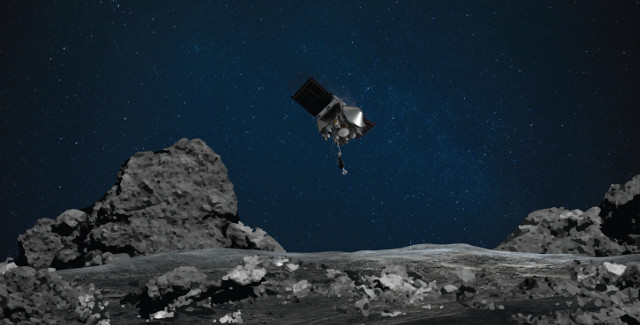
Artist's concept of OSIRIS-REx descending to Bennu's surface (Image NASA/Goddard/University of Arizona)

A few hours ago NASA’s OSIRIS-REx space probe descended to the surface of the asteroid Bennu to take soil samples in what was called TAG (Touch-And-Go). The selected area is in a crater that was named Nightingale with a diameter of about 16 meters in Bennu’s northern hemisphere. The operation was carried out fully automatically because there’s an 18.5 minute delay in communications due to the fact that OSIRIS-REx is about 334 million kilometers from Earth. If the result is satisfactory, this part of the mission will be over.

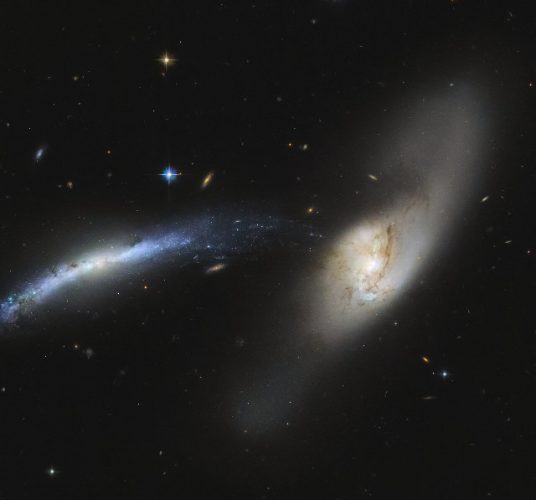
Arp 283 (NGC 2799 and NGC 2798) (Immagine ESA/Hubble & NASA, SDSS, J. Dalcanton Acknowledgement: Judy Schmidt (Geckzilla))

A photo taken by the Hubble Space Telescope shows Arp 283, which is not a single object but a pair of galaxies classified as NGC 2798 (on the right) and NGC 2799 (on the left). Astronomer Halton Arp put this pair in his catalog of peculiar galaxies because they are two interacting galaxies, which means they’re affected by each other’s force of gravity. Arp 283 was compared to a waterspout with stars from NGC 2799 appearing to fall towards NGC 2798 like drops of water. In the distant future, the two galaxies could merge.

Betelgeuse seen by the SPHERE instrument in December 2019 (Image ESO/M. Montargès et al.)

An article published in “The Astrophysical Journal” reports a study of the star Betelgeuse that concludes that it’s smaller and closer to Earth compared to previous measurements. A team of researchers led by Dr. Meridith Joyce of the Australian National University (ANU) used observations conducted using the Coriolis satellite’s SMEI instrument before it started dimming and three different modeling methods to conclude that its radius is about 764 times the Sun’s, its mass is between 16.5 and 19 times the Sun’s and its distance is about 548 light-years from the Earth.

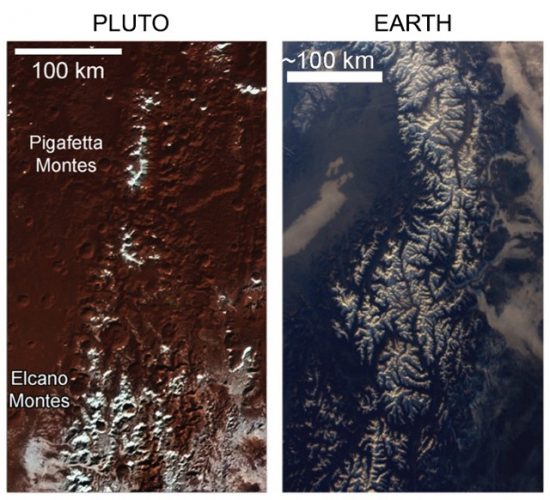
Pigafetta Montes and Elcano Montes on Pluto and the Alps

An article published in the journal “Nature Communications” reports a study that offers an explanation for the origin of the snowpack existing on the highest mountains of the dwarf planet Pluto that create a sort of alpine panorama since it resembles in many ways the Earth’s Alps. A team of researchers used data collected by NASA’s New Horizons space probe to figure out that the snow is mainly composed of methane. This compound can become solid under the conditions present on Pluto and forms that mantle through a process that’s very different from that one that leads to alpine snowfall.

The Soyuz MS-17 spacecraft docking with the International Space Station (Image NASA TV)

A few hours ago the Soyuz MS-17 spacecraft was launched from the Baikonur Cosmodrome in Kazakhstan and after a little more than three hours reached the International Space Station with three astronauts on board: Kate Rubins, Sergey Ryzhikov and Sergey Kud-Sverchkov. For the first time, the ultra-fast route was used which halves the journey duration. In the period preceding a launch, it’s normal for astronauts and cosmonauts to remain in quarantine. In this case it was also extended to the personnel who managed the launch, with limits to the people who could have been in Baikonur.