
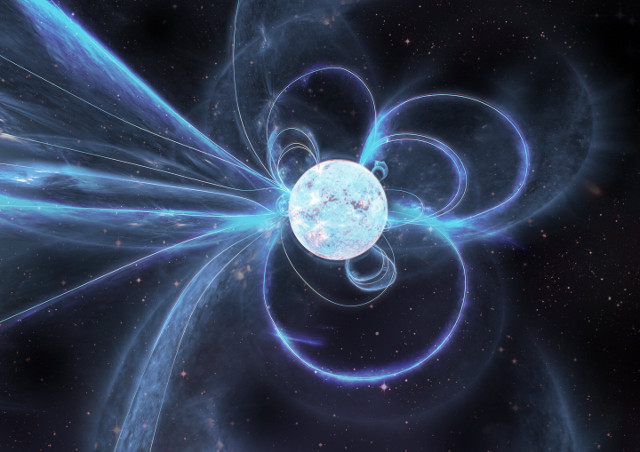
An article published in the journal “Monthly Notices of the Royal Astronomical Society” reports a study on the magnetar Swift J1818.0-1607 that describes its behavior, more complex than expected. A team of researchers led by Marcus Lower of Swinburne University of Technology in Australia observed it between May and October 2020 with the Parkes radio telescope noting that its emissions varied from that of a magnetar to that of a pulsar, alternating typical behaviors of these two types of neutron stars. It eventually settled into the magnetar state, and that can offer insights into the evolution of these strange objects.
Discovered in March 2020 thanks to NASA’s Swift Space Telescope, Swift J1818.0-1607 was initially regarded as the youngest known pulsar. This type of neutron star is characterized by emissions of regular pulses of electromagnetic radiation, but in this case the emissions turned out to be variable very soon. For this reason, an article published in “The Astrophysical Journal Letters” already reported “hybrid” behaviors as both pulsar and magnetar, another type of neutron star characterized by an extraordinarily intense electromagnetic field.
Cases of neutron stars showing both pulsar and magnetar characteristics are known but rare, so various teams of researchers tried to study this new case. Marcus Lower’s team used the Parkes radio telescope in Australia because Swift J1818.0-1607 is also one of the very few neutron stars to also have radio emissions. Eight different observations conducted between May and October 2020 showed for example that this pulsar / magnetar has a very active and dynamic magnetosphere after the X-ray outburst that allowed it to be discovered.
The most anomalous behavior of Swift J1818.0-1607 was in the transition from pulsar to magnetar and vice versa. Astronomers have been studying nutron stars of various types for decades also to try to understand why they become pulsars or magnetars, so these cases of “double personality” are very interesting.
Marcus Lower commented on the bizarre behavior of Swift J1818.0-1607 explaining that it had never been seen before in any other magnetar with strong radio emissions. He explained that it appears to have been a short-lived phenomenon because the subsequent observations he conducted with his colleagues showed that this neutron star seems to have settled permanently into a magnetar state.
The complexity of the behavior of Swift J1818.0-1607 isn’t only given by its state but also by the fact that its magnetic axis is misaligned with respect to its rotation axis. This is a characteristic seen for the first time with certainty in a magnetar.
An out-of-the-ordinary configuration of Swift J1818.0-1607’s magnetic field was already pointed out in a research published in “The Astrophysical Journal” in October 2020 using observations conducted with the NICER (Neutron Star Interior Composition Explorer) instrument on the International Space Station, which has the purpose of measuring X-ray emissions from neutron stars.
According to the researchers, the radio pulses from Swift J1818.0-1607 could be generated by loops of magnetic field lines connecting two close poles, a configuration similar to that of horseshoe magnets or sunspots. Such a configuration is different from most neutron stars.
Various reasons for interest in Swift J1818.0-1607 will lead the researchers to continue their observations of this neutron star. Surely other research teams will also study it and follow its evolution.
