
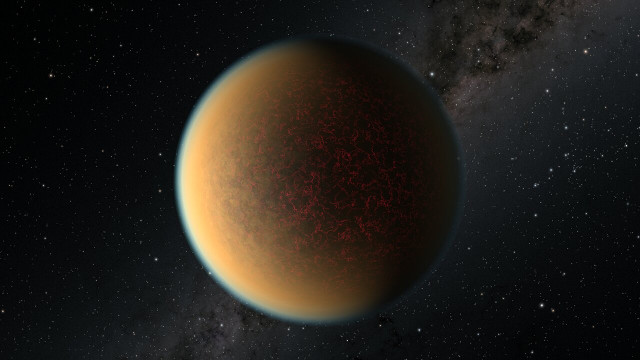
An article to be published in “The Astronomical Journal” reports a study on the atmosphere of the exoplanet GJ 1132 b which indicates that it may have lost its original atmosphere and that a new one was subsequently formed as a result of volcanic activity. A team of researchers led by Mark Swain of NASA’s Jet Propulsion Laboratory used observations conducted with the Hubble Space Telescope to detect the presence of an atmosphere containing hydrogen, hydrogen cyanide, methane, and ammonia with hydrocarbon hazes. According to the researchers, GJ 1132 b may have originated as a sub-Neptune, lost its original atmosphere because it’s very close to its star and therefore very hot, and what is now being detected is a new atmosphere generated by volcanic activity.
Just over 40 light-years from Earth, the exoplanet GJ 1132 b, or Gliese 1132 b, is practically in the neighborhood from an astronomical point of view. Slightly larger and more massive than Earth, it could be called a super-Venus because it has an average distance from its star that is just over 2 million kilometers, so it’s very hot. The star GJ 1132 is a red dwarf with a size and mass of around 20% of the Sun’s, but the exoplanet GJ 1132 b is so close to it that it still receives an amount of emissions estimated to be 19 times what the Earth receives from the Sun.
The surface of GJ 1132 b might be even hotter than that of Venus, but it’s almost certainly tidally locked to its star and always shows the same face, like the Moon with the Earth, so it has a side on which it’s always day. and another on which it’s always night. The night side should be less hot but the atmosphere carries the heat from the dayside, and this makes studying it even more interesting.
Due to the proximity of the exoplanet GJ 1132 b to its star, finding that it has an atmosphere was a surprise. Even a red dwarf has sufficient gravity to erode the atmosphere of a very close planet, also thanks to its expansion caused by heat. It’s possible that GJ 1132 b originated as a sub-Neptunian or a mini-Neptune and then became a rocky planet but that wasn’t the end of its atmosphere’s story.
The forces exerted on the exoplanet GJ 1132 b by its star that made it tidally locked also cause tidal forces that act on the planetary mantle keeping it liquid and leading to significant volcanic activity. We see a similar phenomenon with the influence exerted by Jupiter on its moons, with the consequence that the core of Europa is heated enough to have an underground ocean of liquid water, and the mantle of Io is stressed to the point of being the object with the greatest volcanic activity in the solar system.
The mechanisms that can turn a sub-Neptune / mini-Neptune into a super-Earth are among the current topics of study. An exoplanet like GJ 1132 b can represent a very interesting object of study also from a geological point of view because volcanism generates gas emissions to the point of having generated a new atmosphere and continues to enrich it by compensating for the action of the star, which continues to erode it.

Permalink
Find this information interesting ✅