
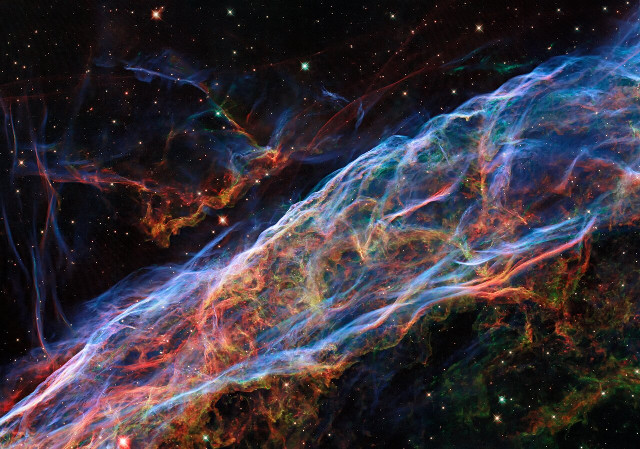
A photo of part of the Veil Nebula captured by the Hubble Space Telescope offers a new view of these supernova remnants after applying new processing techniques. The Veil Nebula has already been at the center of observations, analysis, and processing of the images obtained because those remnants form a vast diffuse nebula that is made up of different parts cataloged with different designations and known by different names. This nebula in turn is only the visible part of the Cygnus Loop, as these supernova remnants must be observed in a wider range of the electromagnetic spectrum to be fully detected.
The Cygnus Loop is estimated to be around 10,000 years old and some of its features made it difficult to measure its distance. According to the information included in the new image’s description, the Veil Nebula is about 2,100 light-years away from Earth, and according to the most recent estimates, the entire Cygnus Loop is about 130 light-years in diameter.
The progenitor star had a mass estimated to be around 20 times the Sun’s, so it consumed its hydrogen very quickly and ended its life in a supernova. The ejection of the outer layers of the star began before the explosion and the subsequent shock wave generated by the supernova with the ejection of other materials at very high speed generated the vast set of nebulae known today.
The Hubble Space Telescope is among the many instruments used over time to study the various parts of the Cygnus Loop. The Veil Nebula is easier to observe because it’s its part visible at optical frequencies. Various filters were applied to obtain details of this nebula with improvements obtained over time thanks to the new instruments installed on Hubble such as the Wide Field Camera 3 (WF3) used for the most recent images.
Image processing techniques also improved over time, and in this case that allowed to obtain more details of the nebula’s ionized gas filaments. In the image, doubly ionized oxygen is represented in blue, ionized hydrogen and nitrogen are represented in red. The new processing makes the image even more spectacular, and from a scientific point of view, it improves it by offering new information on the processes underway millennia after a supernova in remnants that are dispersing into interstellar space.
