April 2021

The 12 Einstein crosses

An article accepted for publication in “The Astrophysical Journal” reports the identification of 12 quasars whose image has been quadrupled by gravitational lenses obtaining images similar to the so-called Einstein Cross. Researchers from the Gaia Gravitational Lenses (GraL) group used data collected by ESA’s Gaia space probe and NASA’s WISE space telescope and examined them with machine learning algorithms. In this way, it was possible to recognize quasar candidates whose image was distorted by gravitational lenses leading to the identification of 12 Einstein crosses.

The double quasars cataloged as J0749+2255 and J0841+4825

An article published in the journal “Nature Astronomy” reports the discovery of two double quasars that could be part of a hidden population because two quasars that are very close are difficult to distinguish. A team of researchers used Hubble Space Telescope observations of quasars to find these pairs dating back to about 10 billion years ago. The two quasars of each pair are about 10,000 light-years apart, and the galaxies that host them will merge and at a certain point the supermassive black holes that power the quasars will merge as well.

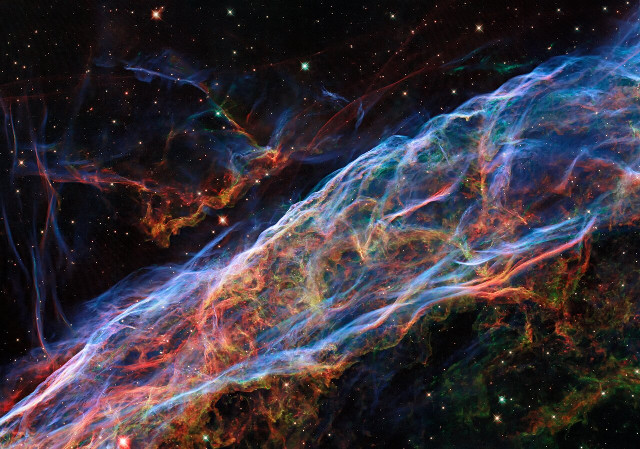
A part of the Veil Nebula (Image ESA/Hubble & NASA, Z. Levay)

A photo of part of the Veil Nebula captured by the Hubble Space Telescope offers a new view of these supernova remnants after applying new processing techniques. The Veil Nebula has already been at the center of observations, analysis, and processing of the images obtained because those remnants form a vast diffuse nebula that is made up of different parts cataloged with different designations and known by different names. This nebula in turn is only the visible part of the Cygnus Loop, as these supernova remnants must be observed in a wider range of the electromagnetic spectrum to be fully detected.

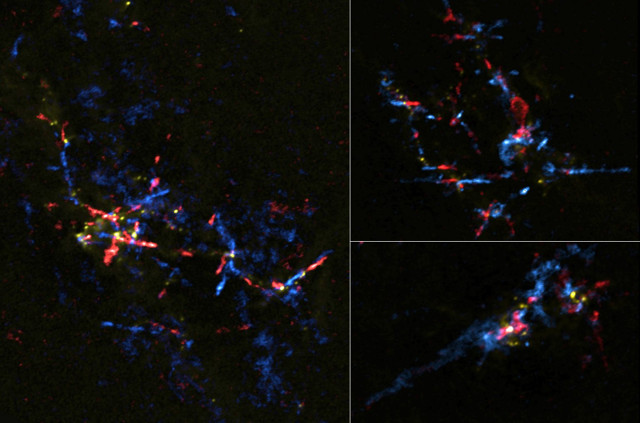
Some outflows indicating an origin from protostars

An article published in “The Astrophysical Journal” reports the discovery of four massive molecular clouds in the central area of ​​the Milky Way with traces of star formation in an area that was considered too chaotic for that to happen. A team of researchers used the ALMA radio telescope to examine the so-called Milky Way’s Central Molecular Zone (CMZ), discovering over 800 of what are considered stellar eggs, meaning dense cores of gas and dust. ALMA made it possible to detect 43 energetic outflows of materials with characteristics associated with star formation, further evidence of what’s happening in that area.